.svg)


Not all email marketing tools are built the same. I learned that the hard way.
I had two clients running similar campaigns at the same time. One on Mailchimp, one on Omnisend. Same type of business, similar list sizes, comparable offers. The results were not close. The Omnisend client was getting cleaner deliverability, more automated touchpoints, and spending less time managing the tool. The Mailchimp client was fighting the platform to do things that should have been straightforward.
Around the same time, a third client wanted the simplest setup possible and chose EmailOctopus. For basic newsletters it worked great. Then they wanted more automation, more segmentation, more control. The platform had a ceiling and they hit it fast.
Moving that client to ActiveCampaign changed everything. The level of control, the automation depth, the reporting. It made it obvious that the tool you start on can either cap your growth or scale with it.
That's what this article is actually about. Not a generic list of email platforms ranked by feature count. A guide for small business owners who are either outgrowing their current tool or picking one they won't have to replace in twelve months.
I have personally used or set up most of the tools on this list with clients. Where I haven't used something myself, I've gone deep on real user feedback from people who have. Here's what I found.
Quick comparison: best email marketing platforms for small business in 2026
1. Beehiiv: Best for newsletters, content creators and consultants building an audience
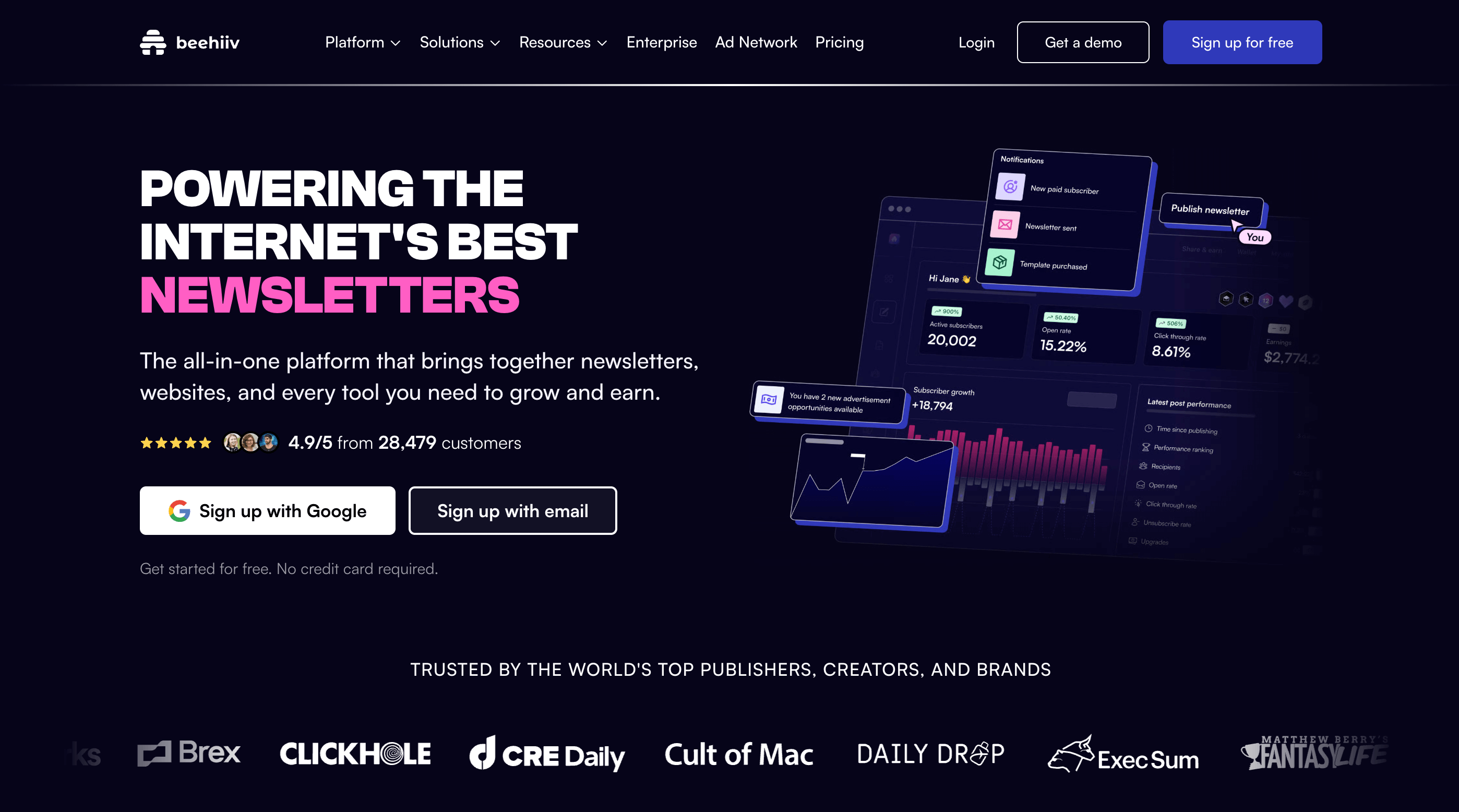
Free plan: Yes, up to 2,500 subscribers | Paid from: $29/month | Offer: 14-day trial plus 20% off for 3 months
Beehiiv was built by former Morning Brew team members, and that background shows in every design decision. This is a platform built by people who have actually grown massive newsletters from scratch, not by engineers guessing what creators need.
What I enjoy about Beehiiv is how clean and modern the interface feels. Writing a newsletter here does not feel like operating software. It feels like using a well-designed publishing tool. They also ship new features at a pace that most platforms cannot match, which means the tool keeps getting better while you are using it.
The monetization infrastructure is what really separates Beehiiv from everything else in this category. The built-in ad network lets you earn directly from your newsletter without chasing sponsorships yourself. The paid subscription feature lets you charge readers for premium content. The referral program rewards subscribers who share your newsletter. These are three separate revenue streams that would normally require stitching together multiple tools.
Clients who have used Beehiiv consistently say the same things. One described it as the best tool they had used for monetizing content, praising the constantly evolving feature set and the responsiveness of the support team. Another, seven months into using the platform, was struck by how quickly new products get launched and how fast the support team responds. A third noted that the ad network alone can generate earnings that exceed the cost of the subscription, making it effectively self-funding once your list reaches a decent size.
The free plan covers up to 2,500 subscribers with unlimited sends, which is genuinely generous. Most competitors either cap sends or lock key features behind paid plans. Beehiiv gives you enough room to validate your newsletter before committing.
Where Beehiiv is not the right fit: if you run an ecommerce store, need complex behavioral automation, or are managing a sales pipeline alongside your email. This is a publishing and audience-growth platform. It does that extremely well. It is not trying to be everything else.
If you're looking to make a switch from Mailchimp to Beehiiv, we have a full breakdown of how Beehiiv vs Mailchimp compare and which is better for newsletter creators. Additionally, many newsletter creators also compare Beehiiv vs Substack before making final decision.
2. ActiveCampaign: Best for small businesses that need serious automation and a built-in CRM

Free plan: No, 14-day free trial | Paid from: $15/month
ActiveCampaign is what happens when email marketing grows up. I have set it up across several client accounts and the shift in what becomes possible, compared to simpler tools, is significant. This is the platform I recommend when a client has outgrown their current tool and needs email to work like a proper revenue system rather than a broadcast channel.
The automation builder is the best I have used. You are not limited to linear sequences. You can build workflows that branch based on what someone clicked, what page they visited, what score they have accumulated, or what stage they are in your sales pipeline. A client I moved to ActiveCampaign from a simpler platform had the same list size but unlocked a level of segmentation and targeting that produced a measurable difference in campaign performance within the first few months.
The built-in CRM is a genuine advantage for service businesses. Instead of paying separately for a sales pipeline tool, you get deal tracking, contact scoring, pipeline management and sales automation inside the same platform as your email. For small teams wearing multiple hats, that consolidation saves both money and context-switching time.
ActiveCampaign's AI features have moved well beyond content suggestions. Beyond email AI writing tools, the AI Campaign Builder lets you describe a goal in plain language and it builds the full campaign, including segmentation and send timing. The Active Intelligence layer goes further: it monitors your performance against goals and proactively flags when something is falling behind, triggering corrective actions before you even notice the problem. Most platforms tell you what went wrong after the fact. This one tries to stop it from going wrong.
Deliverability is independently ranked at 93.4% by EmailTooltester, the highest of any platform on this list. That matters more than most people realize. Roughly 80 more emails landing in inboxes per 10,000 sends is the difference between a campaign that pays for itself and one that quietly underperforms.
The trade-off is real: there is a learning curve. ActiveCampaign is not the tool you pick if you want to be sending within an hour of signing up. But the investment in learning it properly pays off quickly, and their onboarding support on higher plans is solid.
If you are switching from Mailchimp specifically, we have a full breakdown of how ActiveCampaign vs Mailchimp compare and when it makes sense to move.
3. Omnisend: Best email marketing software for ecommerce businesses
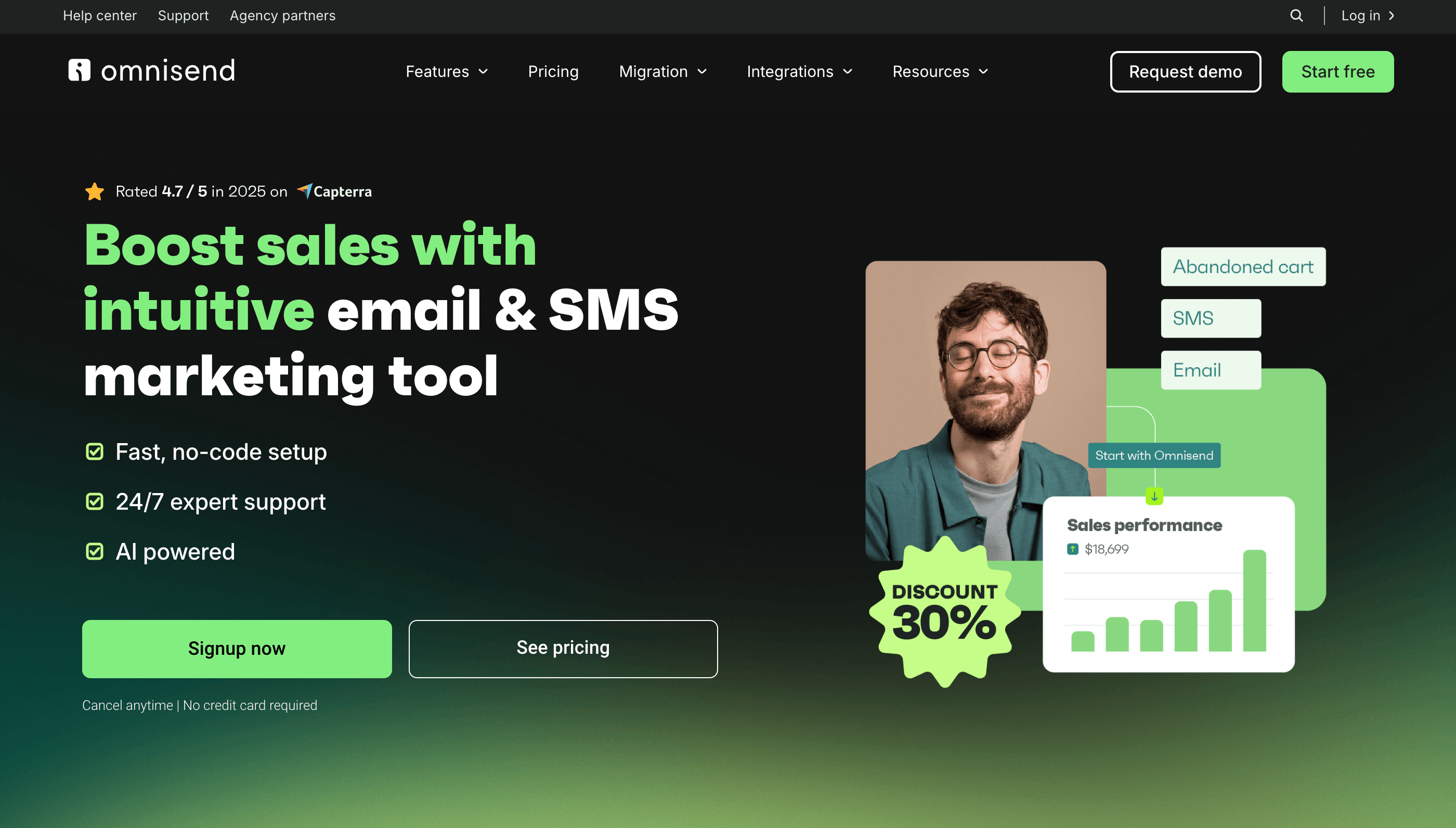
Free plan: Yes, up to 500 emails/month | Paid from: $16/month
If you run an online store, Omnisend was built for you specifically. The platform combines email and SMS into a single unified workflow, pulls in your store data automatically, and makes setting up an abandoned cart sequence feel like something you do in a spare 20 minutes rather than an afternoon project.
What makes Omnisend stand out in the ecommerce category is how smooth the migration experience tends to be. A service provider who has migrated over 20 clients to Omnisend described the process as consistently straightforward, noting how quickly even less technical users get comfortable with the platform once everything is set up. Another business owner who switched from a much more expensive platform found that results held steady while the monthly cost dropped significantly. And a third, migrating from Mailchimp, found the team genuinely helpful throughout the transition, not just at the point of sale.
The interface is clean. The automation builder is visual and approachable. Segmentation lets you filter by purchase history, campaign engagement, location and custom events, which means you are not sending Black Friday emails to someone who just paid full price last week.
Omnisend is less compelling if you are not in ecommerce. The platform's deepest strengths, product-based triggers, store data integration and purchase-history segmentation, are only relevant if you have a store to connect. For service businesses or newsletter operators, other tools on this list are a better fit.
4. Brevo: Best budget email marketing platform with CRM, SMS and automation
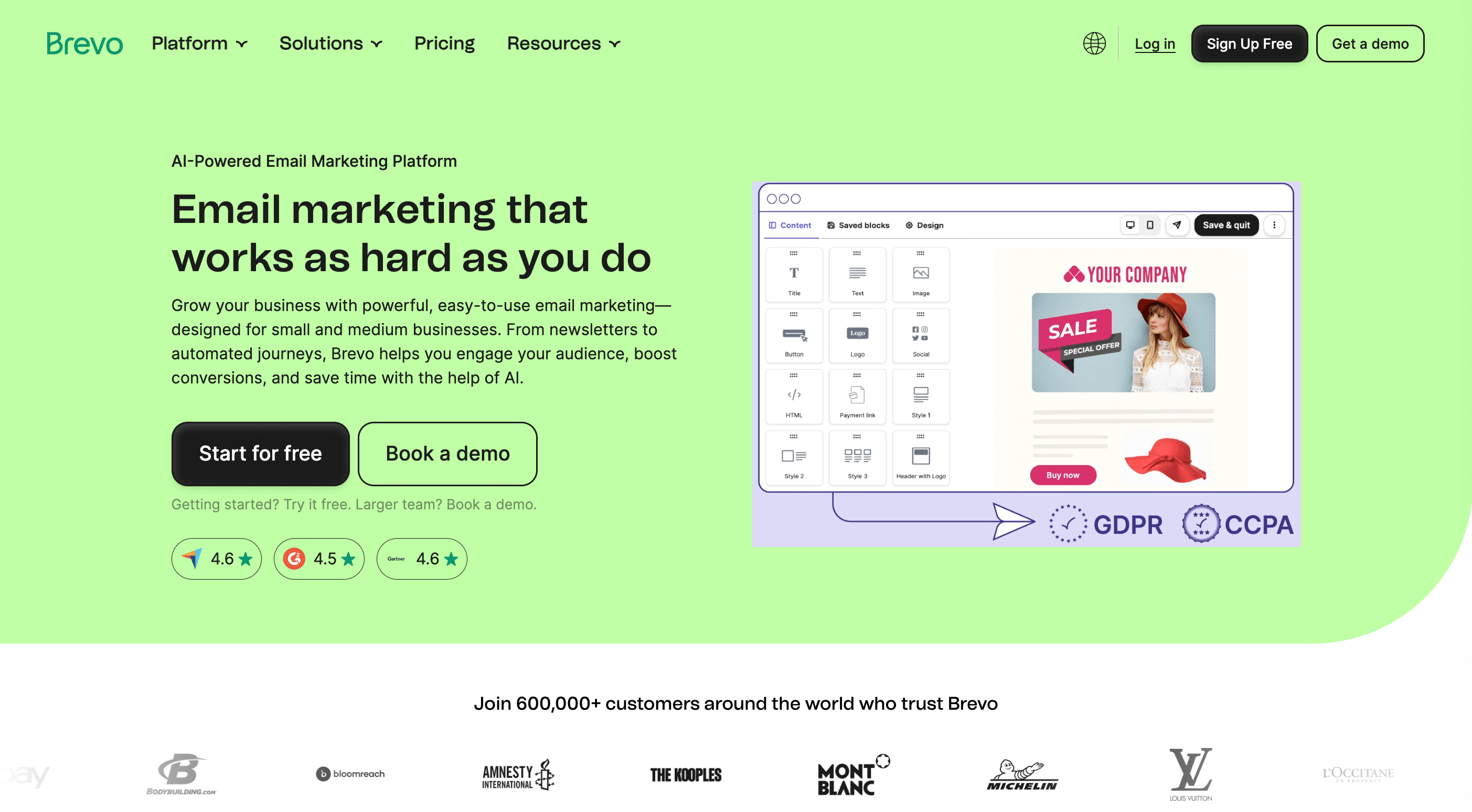
Free plan: Yes, 300 emails/day, unlimited contacts | Paid from: $9/month
Brevo is the most underrated tool on this list. The free plan alone stores unlimited contacts, which no other major platform offers. You pay based on how many emails you send, not how many contacts you store. For service businesses with large prospect lists who send infrequently, that pricing model makes a real difference.
I have used Brevo across campaigns and automations and found the feature set genuinely strong for the price. The automation builder handles multi-step workflows triggered by behavior, date conditions or custom events. The campaign builder is clean. The broader stack covers everything a solo operator needs: built-in CRM, SMS, WhatsApp campaigns, transactional email, live chat. One platform instead of five separate tools.
What clients consistently notice about Brevo is the support. One small business owner described being able to manage all their campaigns independently because the platform is intuitive enough not to require a dedicated marketing person. Another, a free plan user, received a detailed technical response on SMS mass-messaging within an hour of asking. A third noted that once they got past the initial contact setup, the list management became straightforward and the team was quick to explain anything unclear.
The trade-offs worth knowing before you commit: the interface is not the most polished on this list, and some users find it slightly dated compared to newer tools. Advanced automation requires the Business plan. The free plan includes Brevo branding in email footers.
5. GetResponse: Best email marketing tool for coaches, consultants and service businesses
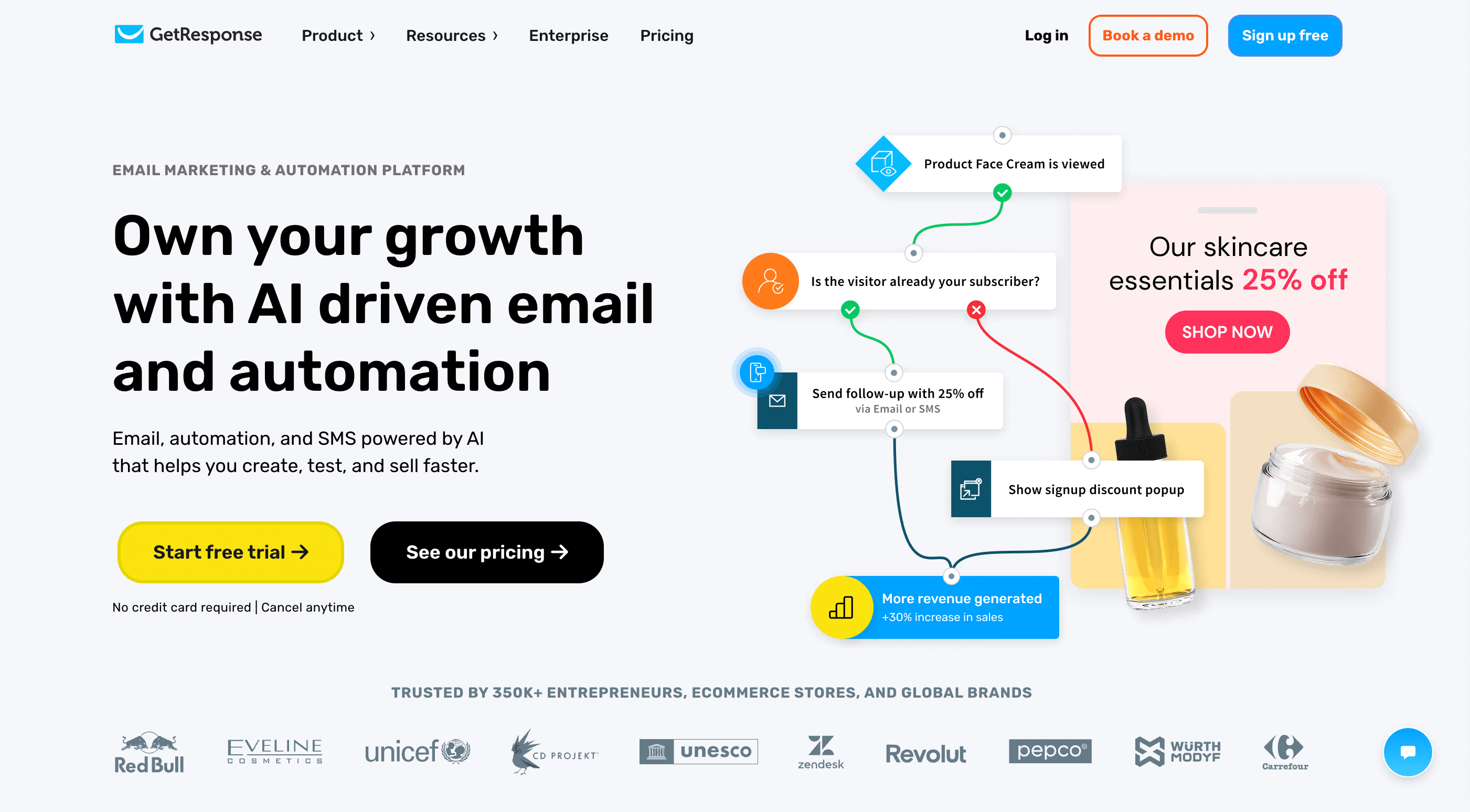
Free plan: Yes, up to 500 contacts | Paid from: $19/month
GetResponse has been around since 1998 and has earned its place on this list through consistent evolution rather than hype. I have used it myself and the thing that strikes me immediately is how intuitive the interface is. You do not spend time figuring out where things are. The automation builder uses a flowchart-style layout that makes complex sequences easy to visualize and edit. Deliverability was excellent in my experience, and the pricing makes sense for businesses that are growing but not yet at enterprise scale.
What makes GetResponse particularly strong for coaches, consultants and professional service providers is the built-in webinar tool. This is not something you find in most email platforms. If you sell through live presentations or run client education sessions, it removes the need for a separate Zoom Webinar or Demio subscription. The Conversion Funnel feature is similarly useful: it walks you through building a lead magnet page, email sequence and sales page as a connected workflow rather than three separate projects.
Clients who use GetResponse tend to stay on it. One long-term user described the pricing as fair, the support as dependable, and the feature set as accessible regardless of technical experience level. Another highlighted how easy it is to create landing pages alongside newsletters, specifically calling out the quality of the customer support team when working through a technical issue.
GetResponse works well as both a starting point and a scaling tool. It is approachable enough for someone just beginning with email marketing and capable enough that you are unlikely to hit a ceiling quickly.
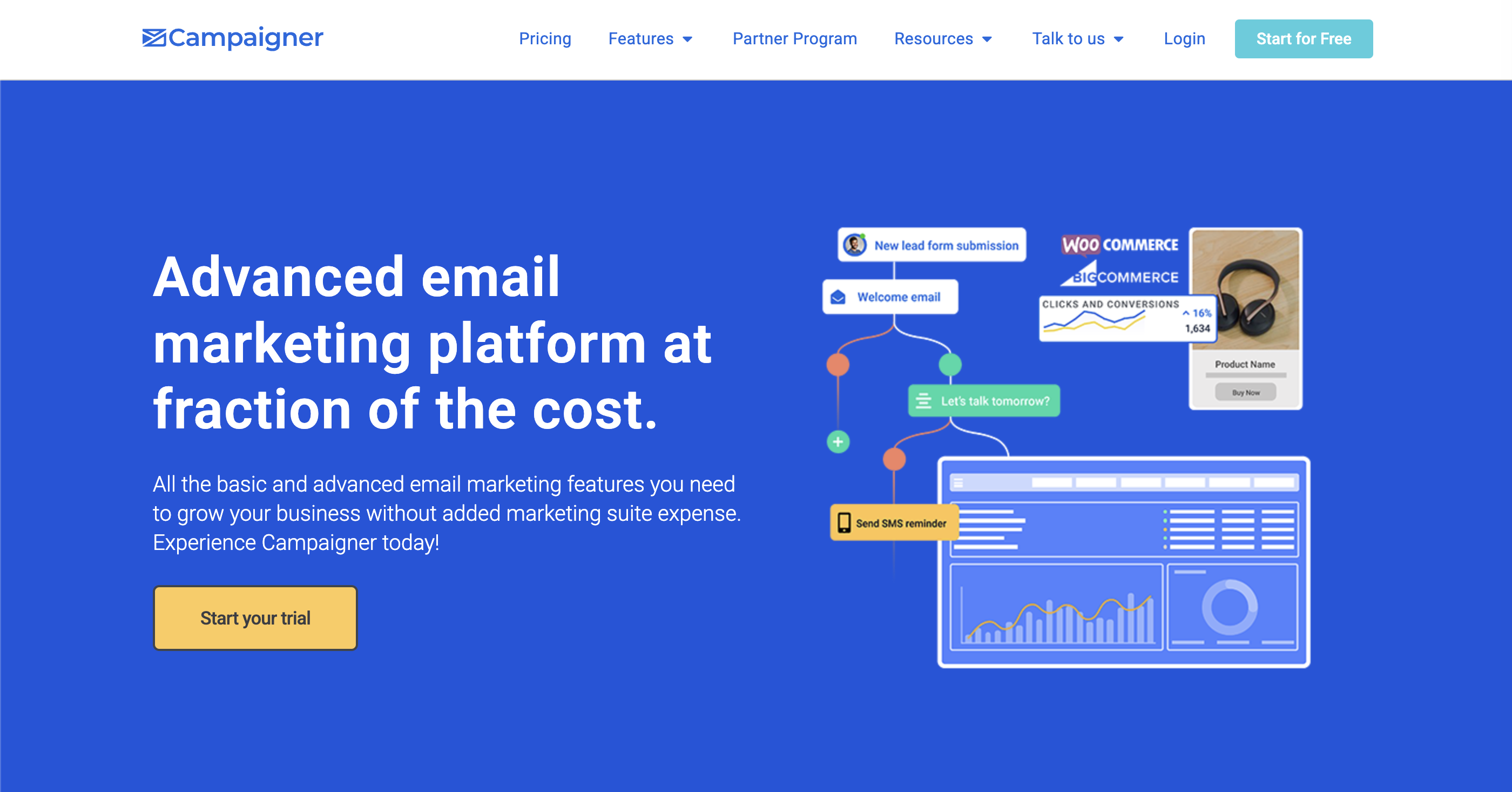
6. Campaigner: Best for businesses where deliverability is non-negotiable
Free plan: 30-day free trial | Paid from: $59/month | Offer: 10% off
Campaigner does not have the brand recognition of the other tools on this list, but it has something more valuable for a specific type of business: a long track record of doing one thing extremely well.
The platform's reputation is built on deliverability and support. One business that has used Campaigner for eight years described their inbox placement as consistently excellent throughout, and their support team as one of the most responsive they have encountered in any software category, typically responding to requests within minutes and resolving them within hours. For businesses where email is a core revenue channel and downtime or deliverability issues carry real costs, that kind of reliability matters more than the flashiest feature set.
Campaigner includes segmentation, automation workflows, A/B testing, landing pages and reporting. It is not the most beginner-friendly entry point, and the starting price is higher than most on this list. But for businesses that have been burned by deliverability problems on cheaper platforms, the track record makes it worth considering.
7. EmailOctopus: Best for solopreneurs and early-stage businesses keeping it simple
Free plan: Yes, 2,500 subscribers and 10,000 emails/month | Paid from: $9/month
EmailOctopus is the honest starting point. No bloat, no steep learning curve, no features you will never use. I have set it up with clients who were testing their first newsletter before committing to a paid platform, and it handled that job well.
The free plan is one of the most generous available at this level: 2,500 subscribers and 10,000 sends per month at no cost. The drag-and-drop editor is clean and you can have a professional-looking campaign out the door quickly.
The ceiling is real though. Once you need conditional automation branching, advanced segmentation or CRM integration for small business management, EmailOctopus will not get you there. I have seen clients outgrow it within months of their list picking up momentum. Think of it as the right tool for the first chapter, not the whole book.
How to choose the right email marketing software when switching
The question is not which tool has the most features. It is which tool fits where your business is right now and where it is heading in the next 12 months.
If you are building a newsletter or content-driven business and want to monetize your audience, start with Beehiiv. Nothing else comes close for this use case.
If you run an ecommerce store and need email and SMS to work as a unified system, Omnisend is the most purpose-built option available.
If you are a service business, coach or consultant who needs automation that responds to behavior, a CRM in the same platform, and deliverability you can rely on, ActiveCampaign is the most capable tool at this price range. It takes longer to learn but it earns that investment back.
If budget is the primary constraint and you want the most tools for the least money, Brevo is genuinely difficult to beat. Unlimited contacts on a free plan is a real advantage.
If you sell through webinars, funnels or live education, GetResponse bundles what you would normally need three tools to do.
If deliverability is your single biggest concern and you need a platform with a long reliability track record, Campaigner is worth the higher entry price.
And if you are just starting out and want to send your first newsletter without overthinking it, EmailOctopus gets you there cleanly.
Frequently Asked Questions About Email Marketing Software for Small Businesses
More from
Tools and Apps
category