.svg)


A strong nursing resume makes it easy for an employer to understand three things quickly: your nursing credentials, the care settings where you have worked or trained, and the skills that match the role.
Whether you are applying for your first RN job, a nurse residency, a specialty unit, or your next experienced-nurse position, your resume should do more than list jobs in date order. A resume is a marketing document: it presents your professional value, clinical background, and readiness for a specific opportunity in a format that is easy for both recruiters and hiring teams to scan.
This guide includes a nursing resume example, section-by-section writing advice, new-grad and experienced-RN guidance, nursing resume skills, and editable template options for Word, Google Docs, and Canva.
Find the Right Nursing Resume Help
Choose the section that best matches your situation:
What Employers Look for on a Nursing Resume
A recruiter or nurse manager should not have to hunt for the essentials. Your resume should make the following information visible without requiring them to read every bullet point:
- Active license or licensure eligibility, including state or region where appropriate
- Nursing degree, graduation date or expected graduation date for new graduates
- Care settings, units, patient populations, and clinical specialties
- Relevant certifications, such as BLS, ACLS, PALS, NIHSS, or others you genuinely hold
- Technical and clinical skills that match the vacancy
- EHR or documentation systems you have used, when relevant
- Results, responsibilities, leadership, education, or patient-care contributions that demonstrate fit
Do not add every nursing term you have seen online. Use terminology that accurately reflects your training and experience, especially terms that appear in the job description.
For example, an RN applying to a telemetry role may emphasize cardiac monitoring, rhythm interpretation if qualified, patient assessment, medication administration, escalation of changes in condition, discharge teaching, interdisciplinary collaboration, and electronic documentation. A new graduate should only list skills learned through education, simulation, clinical rotations, preceptorships, or supervised practice.
Nursing Resume Example
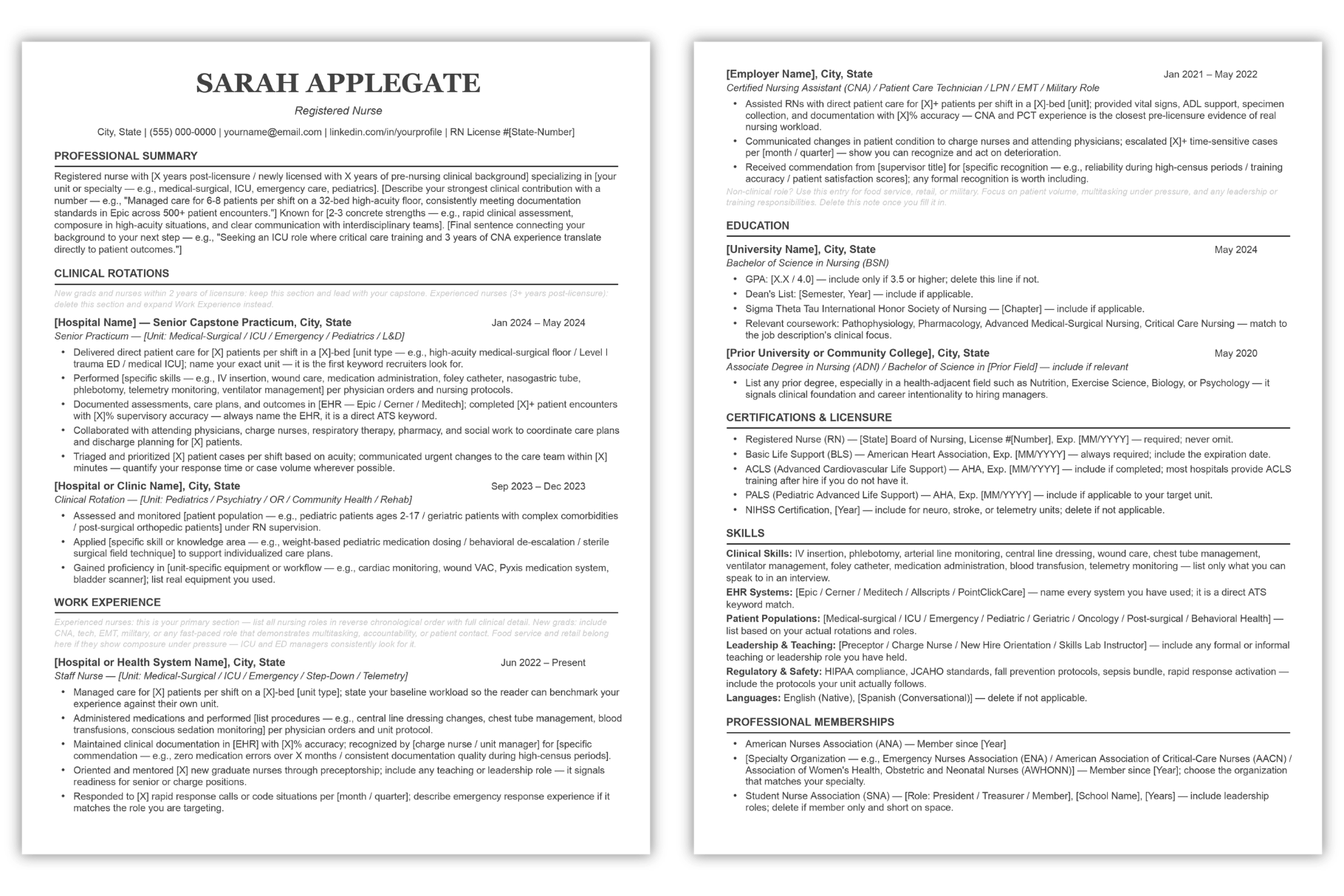
The example below is fictional. It is designed to show how a new graduate RN can present education, licensure, clinical rotations, certifications, and nursing skills in a clear, recruiter-friendly format.
Why This Nursing Resume Works
This example works because it puts the information most relevant to a nursing employer in a predictable order.
License and certifications appear near the top
Your RN license and active certifications are qualifications a hiring team may need to confirm immediately. If you are not licensed yet, state your honest status, such as:
NCLEX scheduled for [month and year]
or:
RN license pending; eligible to sit for NCLEX in [month and year]
Do not list yourself as an RN if you are not yet licensed.
Clinical experience is written as relevant experience
For new graduates, clinical rotations are meaningful experience. Present them clearly with the unit, facility, dates, patient population where relevant, and the care activities you performed under supervision.
The second version shows what you actually did and gives a recruiter more useful context.
Skills are specific but truthful
Skills should reflect your education, supervised practice, paid work, and current credentials. Avoid listing advanced procedures, software, specialties, or certifications you have not used or earned.
A resume is not improved by a longer keyword list. It is improved when the relevant employer can easily identify credible evidence of fit.
How to Write a Nursing Resume

A nursing resume usually works best when it follows a clear one-column format with standard headings. This is easier for recruiters to scan and usually easier to edit for different opportunities.
Use these core sections:
- Contact information
- Professional summary or objective
- Licensure and certifications
- Clinical experience or professional experience
- Education
- Nursing skills
- Optional sections, such as professional memberships, volunteer work, research, leadership, languages, or awards
1. Start with a clear contact section
Include:
- Full name
- City and country, state, or region as relevant to the job market
- Professional email address
- Phone number, including country code if applying internationally
- LinkedIn URL, if current and professional
- License information, either here or in a dedicated section beneath your summary
Avoid adding unnecessary personal information, such as date of birth, marital status, full street address, photo, or immigration details unless they are required and customary in the country where you are applying.
2. Write a targeted nursing resume summary
A summary is most useful when you have professional experience, a defined specialty, or qualifications that need quick context. New graduates can use a concise professional objective instead.
Your summary should answer:
- What type of nurse are you?
- How much relevant experience do you have?
- What setting, specialty, or patient population is most relevant?
- What strengths or credentials make you a credible fit for this role?
Keep it to two or three focused sentences.
Nursing Resume Summary Examples
New graduate RN resume summary: Newly licensed Registered Nurse with clinical experience in medical-surgical, telemetry, emergency, and long-term-care settings. Prepared to contribute patient-centered care, accurate documentation, patient education, and clear interdisciplinary communication in a structured nurse residency or staff RN role.
Experienced medical-surgical RN summary: Registered Nurse with five years of medical-surgical experience providing coordinated care for adult patients with acute and chronic conditions. Skilled in patient assessment, medication administration, discharge education, electronic documentation, and collaboration across interdisciplinary teams. Seeking to bring strong clinical judgment and patient advocacy to a hospital-based RN role.
ICU nurse resume summary: Critical care Registered Nurse with four years of ICU experience supporting complex adult patients in a high-acuity environment. Experienced in detailed assessments, multidisciplinary coordination, family communication, documentation, and escalation of changes in patient condition. Holds current RN license and applicable critical-care certifications.
Emergency department nurse resume summary: Emergency Department Registered Nurse with three years of experience supporting rapid assessment, prioritization, patient education, and collaborative care for patients across varied acuity levels. Brings calm communication, strong documentation habits, and a patient-safety focus to fast-paced clinical environments.
Long-term-care nurse resume summary: Registered Nurse with experience supporting residents in long-term-care and skilled-nursing settings. Skilled in medication management, care-plan support, family communication, documentation, infection-control practices, and coordination with interdisciplinary teams.
Use the wording only if it is accurate. A summary should be adapted to the position, not copied unchanged into every application.
Nursing Skills and Keywords
Keywords is the actual job description, not a generic list from the internet.
Review the posting and look for repeated terms connected to:
- Specialty or unit
- Patient population
- Care setting
- Certifications
- Documentation systems
- Procedures
- Care coordination
- Patient education
- Leadership or precepting
- Quality, safety, or compliance responsibilities
Then use relevant phrases naturally within your summary, skills section, and experience bullets.
General nursing skills
Patient assessment, medication administration, care planning, clinical documentation, patient and family education, infection prevention, vital-sign monitoring, pain management, fall prevention, discharge planning, interdisciplinary collaboration, SBAR communication, electronic health records, HIPAA and patient privacy practices, emergency response protocols.
Medical-surgical nurse resume skills
Adult patient care, post-operative care, patient assessment, medication administration, wound care (if trained), discharge education, care coordination, IV therapy (if trained and within scope), electronic documentation, fall-prevention practices.
ICU nurse resume skills
Only include skills that accurately match your training and experience.
High-acuity patient monitoring, detailed patient assessment, hemodynamic monitoring (if applicable), ventilator care (if applicable), central-line care (if applicable), critical-care documentation, family communication, rapid escalation of changes in patient condition, multidisciplinary rounds, critical-care certifications (if current).
Emergency department nurse resume skills
Triage support (if trained and applicable), rapid patient assessment, emergency documentation, trauma-informed communication, prioritization in high-volume settings, patient and family education, collaboration with emergency care teams, infection-control procedures, emergency response protocols.
Long-term-care nurse resume skills
Resident assessment, medication management, care-plan support, family communication, chronic-condition monitoring, long-term-care documentation, infection prevention, fall prevention, interdisciplinary collaboration, resident-centered care.
EHR and software skills
List named systems only if you have actually used them. Depending on your experience, this might include:
- Epic
- Cerner
- MEDITECH
- PointClickCare
- Allscripts
- eClinicalWorks
- Other electronic health record or scheduling systems
If you have used an EHR only during clinical rotations, you can phrase it accurately:
Familiar with supervised clinical documentation in [system name].
How to Tailor Your Resume to a Nursing Job
Do not send the same resume to every hospital, unit, clinic, or care provider without reviewing it first. A small amount of tailoring can make the application more relevant without changing the truth.
Use this five-step process:
- Read the job description and highlight the required license, certifications, care setting, specialty, patient population, and technical skills.
- Compare those requirements with your actual background.
- Move the most relevant information higher on your resume.
- Use the employer's terminology when it truthfully describes your experience.
- Remove irrelevant or outdated content that distracts from the target role.
For example, if a vacancy emphasizes telemetry, patient education, electronic documentation, and discharge planning, those should appear in your most relevant clinical or employment bullets if they are part of your real experience.
Do not force every phrase from the job description into your resume. Accuracy matters more than keyword density.
New Grad Nurse Resume

If you are a new graduate, it is normal to have limited paid RN experience. Your resume should emphasize evidence that you are prepared to make the transition from student nurse to professional nurse.
What to include on a new-grad nursing resume
- Nursing degree and graduation date
- Licensure status or NCLEX eligibility
- BLS and other current certifications
- Senior practicum, capstone, or preceptorship
- Clinical rotations relevant to the job
- Nursing skills developed under supervision
- Student leadership, relevant volunteer work, honors, or healthcare employment
- Relevant transferable experience, such as CNA, medical assistant, unit clerk, caregiver, EMT, or customer-facing roles, when applicable
Where should clinical rotations go?
Place clinical rotations under Clinical Experience, not in a vague "Education Activities" section. Include the care setting and enough detail to show your exposure.
Example:
Clinical Rotation, Pediatric Unit
Example Children's Hospital, City, Country
September 2025–December 2025
- Supported supervised nursing care for pediatric patients and families in a hospital setting.
- Participated in patient assessments, documentation, medication-related workflows, comfort measures, and family education under RN supervision.
- Collaborated with nurses and the care team while following safety, privacy, and infection-prevention procedures.
New-grad nurse resume objective example
New graduate Registered Nurse with supervised clinical experience in adult medical-surgical and telemetry units. Licensed in [state/country] or eligible to sit for NCLEX in [month/year]. Seeking a nurse residency or staff RN opportunity where I can contribute safe patient care, strong communication, and a commitment to continued clinical development.
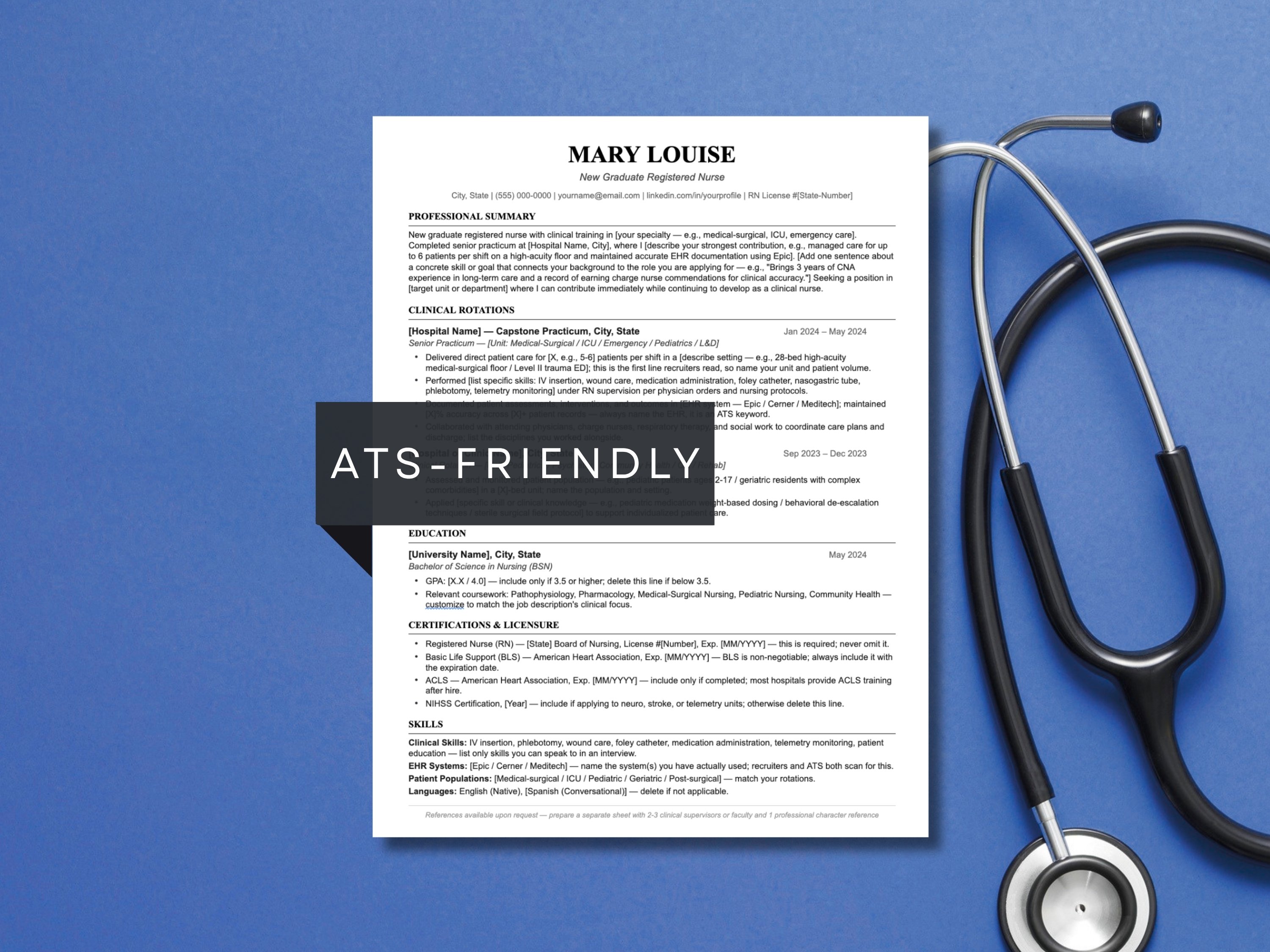
Template for new graduate nurses
Experienced Nurse Resume

Experienced nurses should lead with their professional background, relevant specialty, results, and current qualifications.
Your resume does not need to list every task you completed in every role. Focus instead on the scope of your role, the care setting, the populations you supported, and contributions that show clinical competence, collaboration, safety awareness, leadership, or efficiency.
What to include on an experienced RN resume
- RN license and relevant certifications
- Specialty, unit, or care setting
- Years of experience when meaningful
- Patient population or acuity, when relevant
- Key responsibilities and clinical skills
- Precepting, charge nurse, leadership, education, committee, or quality-improvement work
- Measurable results only when they are accurate and you can explain them
- EHR or clinical systems used, when relevant to the vacancy
Experienced RN bullet examples
Use these as models, not statements to copy word for word.
Medical-surgical RN
- Provided patient-centered nursing care for adult medical-surgical patients, completing assessments, administering medications, documenting care, and coordinating discharge education.
- Collaborated with physicians, therapists, case managers, and other care-team members to support safe transitions of care.
- Educated patients and families on treatment plans, medications, follow-up care, and self-management needs.
Telemetry RN
- Monitored patient status and communicated relevant changes in condition to the appropriate members of the care team.
- Supported care for patients requiring cardiac monitoring while maintaining timely, accurate clinical documentation.
- Participated in bedside handoff, patient education, and interdisciplinary care planning.
Long-term-care RN
- Coordinated nursing care for residents in a long-term-care setting, including assessments, medication-related responsibilities, documentation, and family communication.
- Supported individualized care plans in collaboration with residents, families, providers, and interdisciplinary staff.
- Followed infection-prevention, safety, privacy, and documentation procedures in daily practice.
Charge nurse or leadership contribution
- Supported shift coordination by communicating staffing priorities, assisting team members, and escalating patient-care concerns when appropriate.
- Served as a resource for new team members, students, or colleagues within the boundaries of role, policy, and experience.
Template for experienced RNs
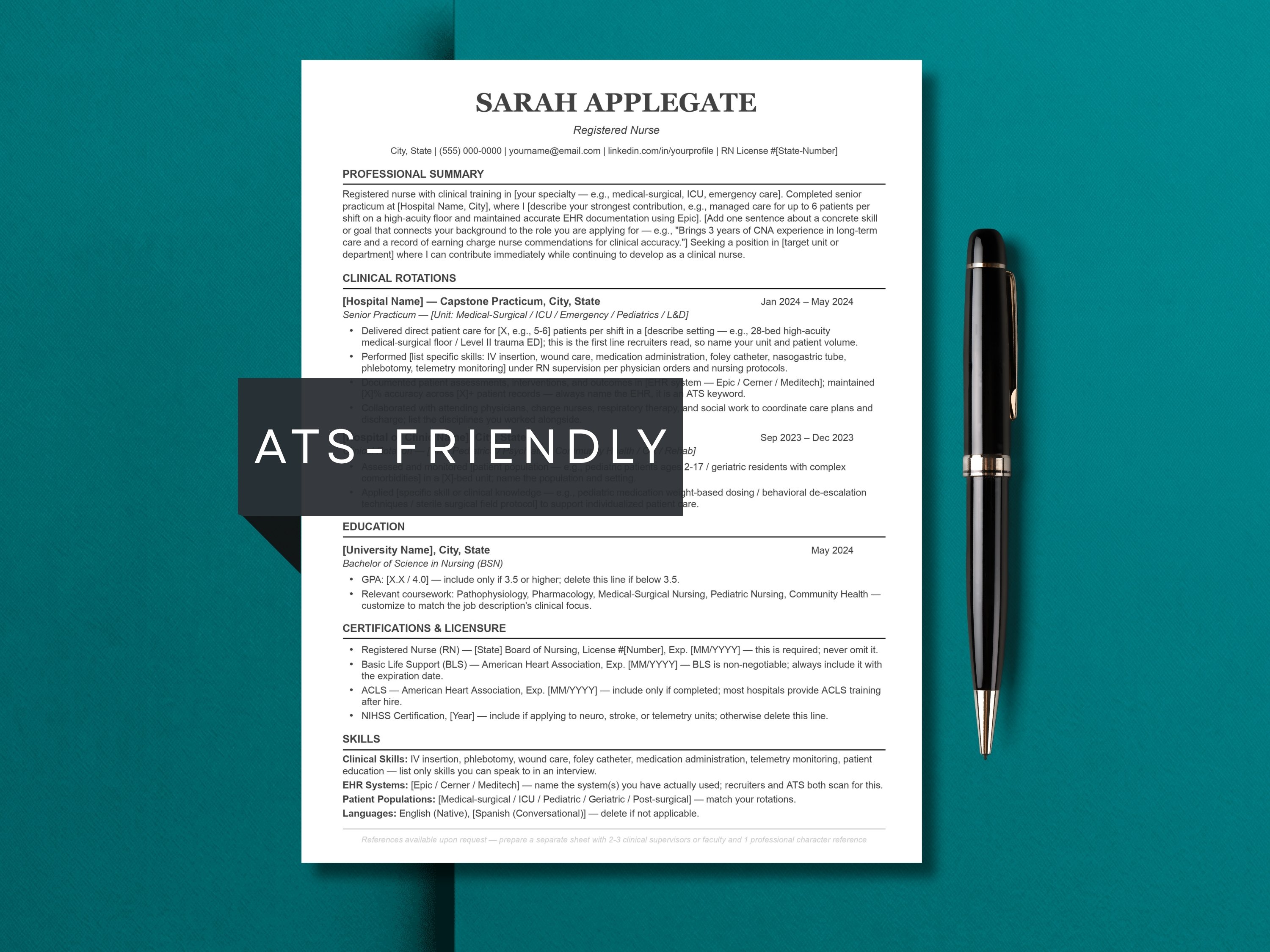
Canva nurse resume template
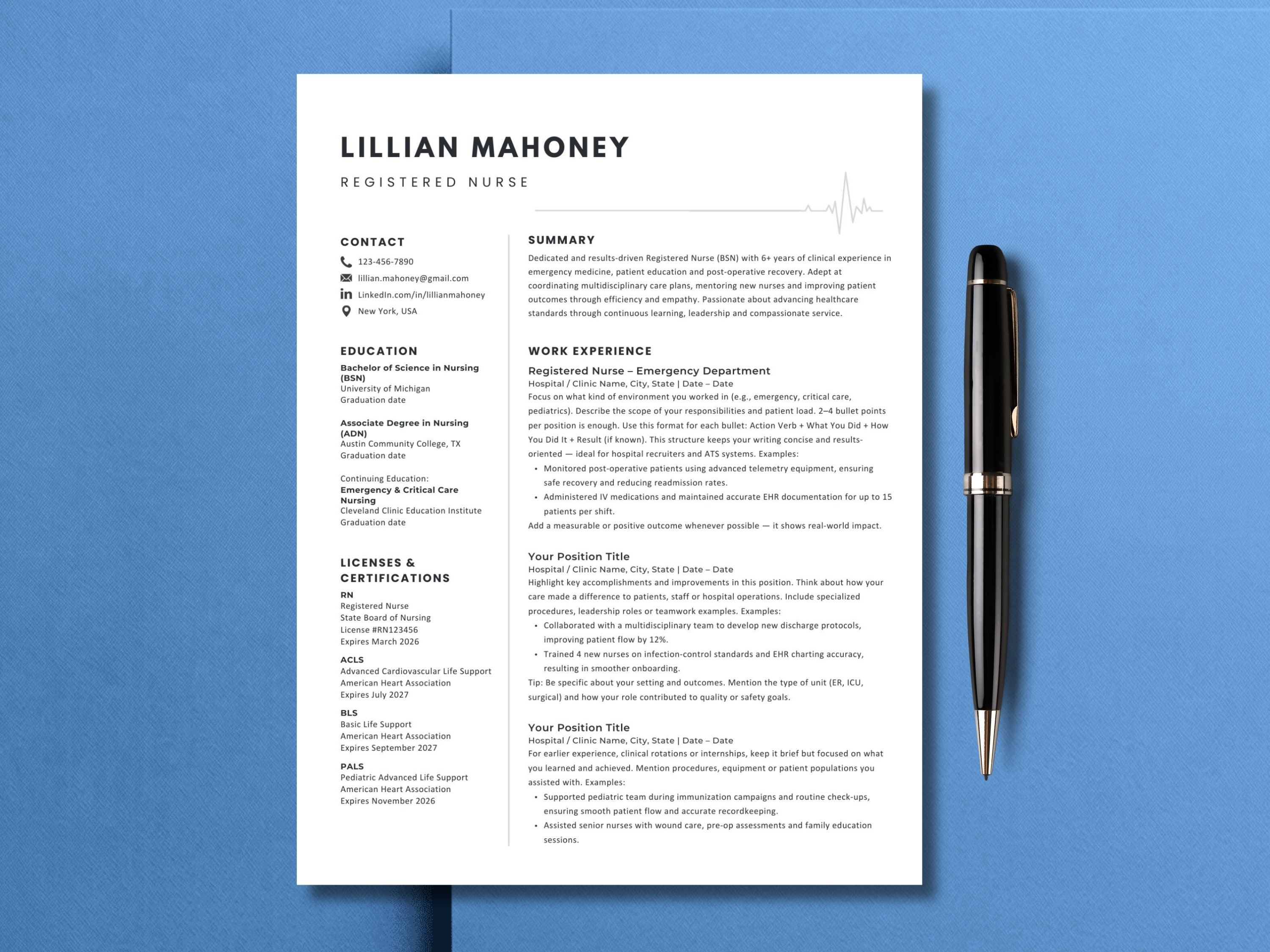
Choosing the Right Nursing Resume Format
For most nursing roles, a reverse-chronological resume is the safest choice. It starts with your most recent relevant experience and lets a recruiter see your career progression quickly.
A two-page resume is not automatically better. Use the space only when it helps an employer understand why you are qualified.
Should nurses use a two-column resume?
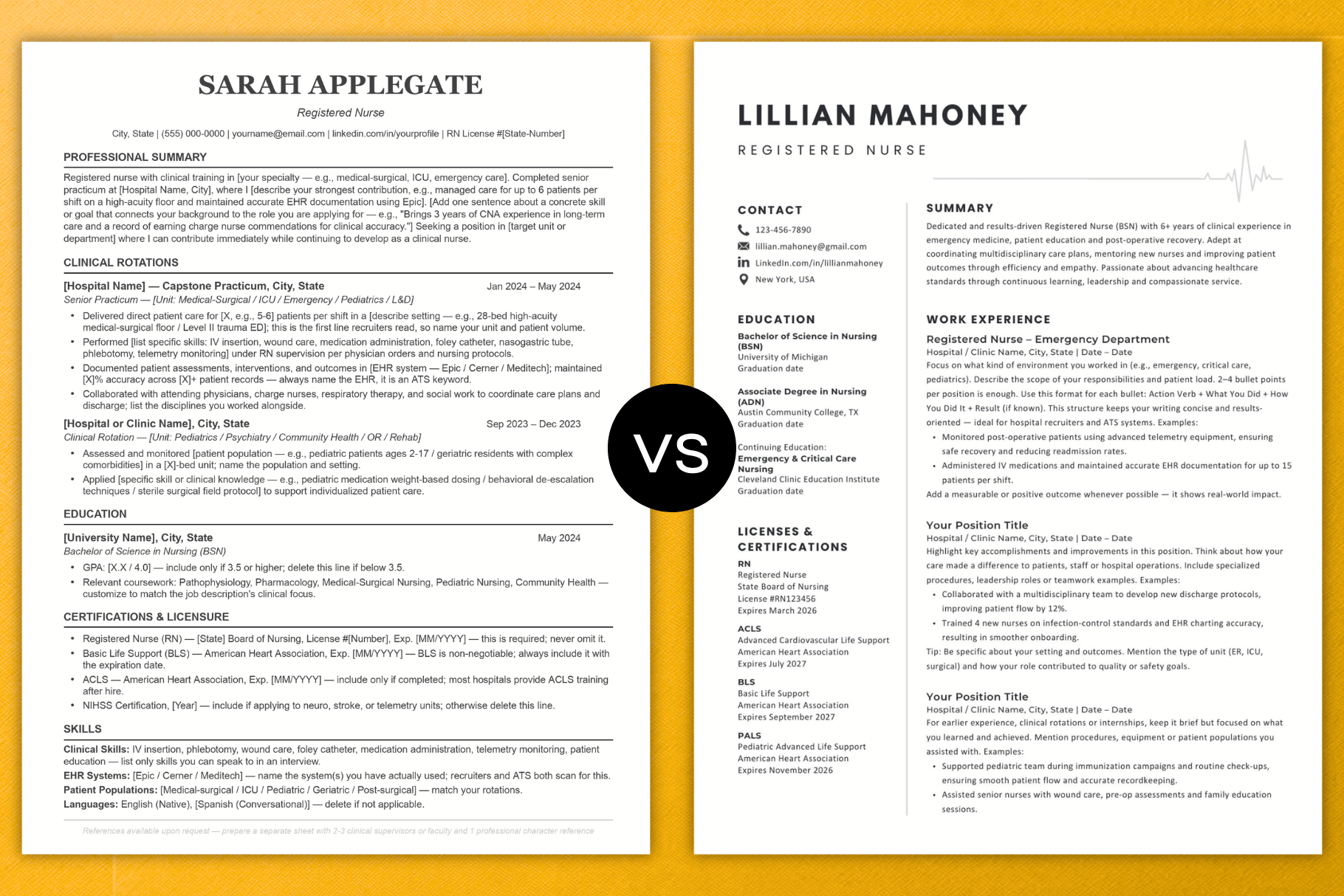
A simple one-column resume is generally the most practical option for nursing applications because it is easy to scan, edit, print, and tailor. It also keeps important information (license, certifications, skills, and work history) in a predictable reading order.
If you choose a more visual resume layout, make sure the essential information remains readable, editable, and easy to locate.
Nursing Resume Mistakes to Avoid
Listing duties without showing relevance: A generic list of tasks can make every role sound the same. Add useful context about the unit, patient population, responsibilities, collaboration, or outcomes where you can do so accurately.
Hiding your license or certifications: Do not make an employer search for the credentials that establish your eligibility. Put them near the top of the document.
Using one resume for every nursing role: An ICU role, nurse residency, pediatric role, long-term-care position, and telehealth position may value different experience. Tailor the summary, skills, and bullets to the vacancy.
Including skills you cannot support: Do not list a procedure, system, specialty, or credential solely because it appears in the job description. Employers may ask about it during an interview.
Overloading the page: Small fonts, long paragraphs, dense skills lists, and unnecessary design elements make your resume harder to use. Choose a clean format with enough white space.
Using vague claims: Replace phrases such as "excellent nurse," "hard worker," or "team player" with evidence.
Frequently asked questions
More from
Resume and Career
category