.svg)


The moment you hire someone outside your own country, you inherit a whole new set of rules you never signed up to learn: employment contracts, tax withholding, social contributions, termination law, all specific to a place you may have never worked in yourself. Get any of it wrong and the fines are real, not theoretical. A global payroll service or Employer of Record (EOR) exists precisely to take that legal weight off your plate so you can focus on the hire itself instead of the paperwork behind it. This has stopped being a niche service too: the global employer of record market is valued at USD 5.97 Billion in 2026 and is projected to reach USD 10.45 Billion by 2035, according to Business Research Insights.
Here's the annoying part though: every single one of these providers promises the exact same thing on their homepage. Compliant hiring, on time pay, one tidy dashboard for your whole international team. Then you actually dig in and the differences are massive, and expensive if you guess wrong. Prices alone swing from $199 to $770 per employee per month for what looks like the same core service everywhere you look.
So I figured it might be helpful to compare these payroll and HR platforms: their published pricing, country coverage, compliance models (owned entities vs third-party partners), check verified reviews on G2, Capterra and Trustpilot, and community sentiment from places like r/Payroll and r/HR to separate the signal from the noise. Here's what I found.
Quick Comparison of Top Global Payroll and HR Platforms for Remote Hiring
Short on time? Here's my top 3 picks:
1. Deel if you want the safe, all-round choice with the widest coverage and fastest onboarding.
2. Payoneer Workforce Management if you're hiring one to five people abroad and every dollar of burn matters.
3. Rippling if you want payroll, HR and IT running as one workforce management platform instead of five disconnected tools.
1. Deel: Best Overall Global Payroll and Contractor Management
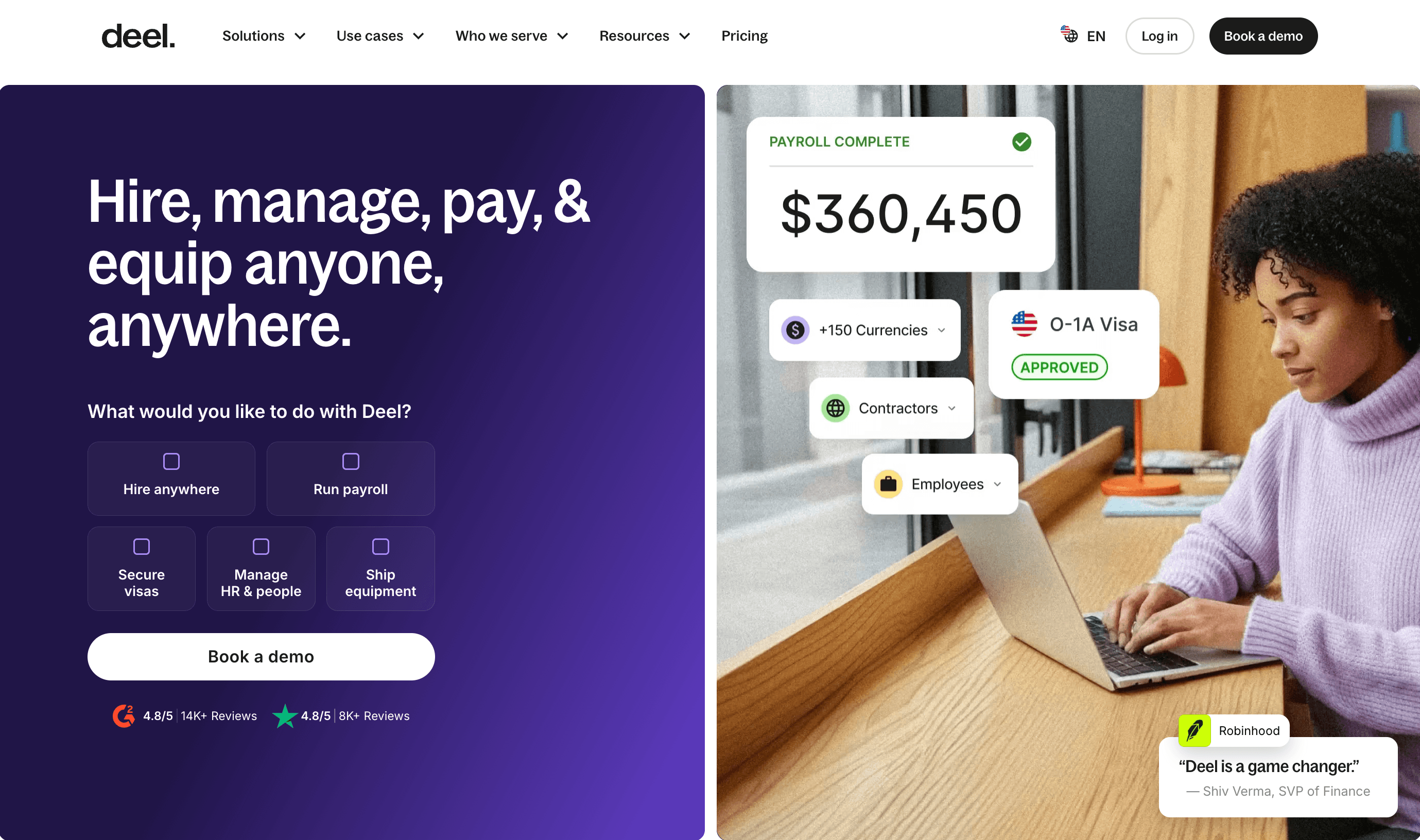
Deel is the safe default for international hiring in 2026, and honestly, the numbers back that up rather than it just being a marketing line. It covers 150+ countries for both employees and contractors, onboards contractors in as little as a day, and G2 keeps ranking it the leading Employer of Record (EOR) service by user satisfaction and market presence. If you don't have three weeks to burn researching providers, Deel is the one that will rarely let you down.
I've actually been on the receiving end of Deel myself, both as a contractor and later as an employee, and that's a big part of why I keep pointing people toward it. Signing the contract, tracking hours, pulling out my pay, none of it made me stop and go "wait, how does this work?", which is rarer than it should be in this category. The benefits and perks were a genuinely nice surprise too, not the usual afterthought bolted onto an EOR platform. It's the platform I'd want my own hires using, mostly because so little about using it made me pause.
What you actually get is genuinely all in one: EOR employment, contractor management, global payroll for countries where you already own entities, immigration and visa support, background checks, even equipment shipping for new hires. Deel owns its legal entities in around 30 key markets (the US, UK, Germany, Canada, Australia, Singapore and others) and works through vetted local partners everywhere else. And its pricing is published right there on the website, which is still surprisingly rare in an industry where most vendors hide everything behind a sales call.
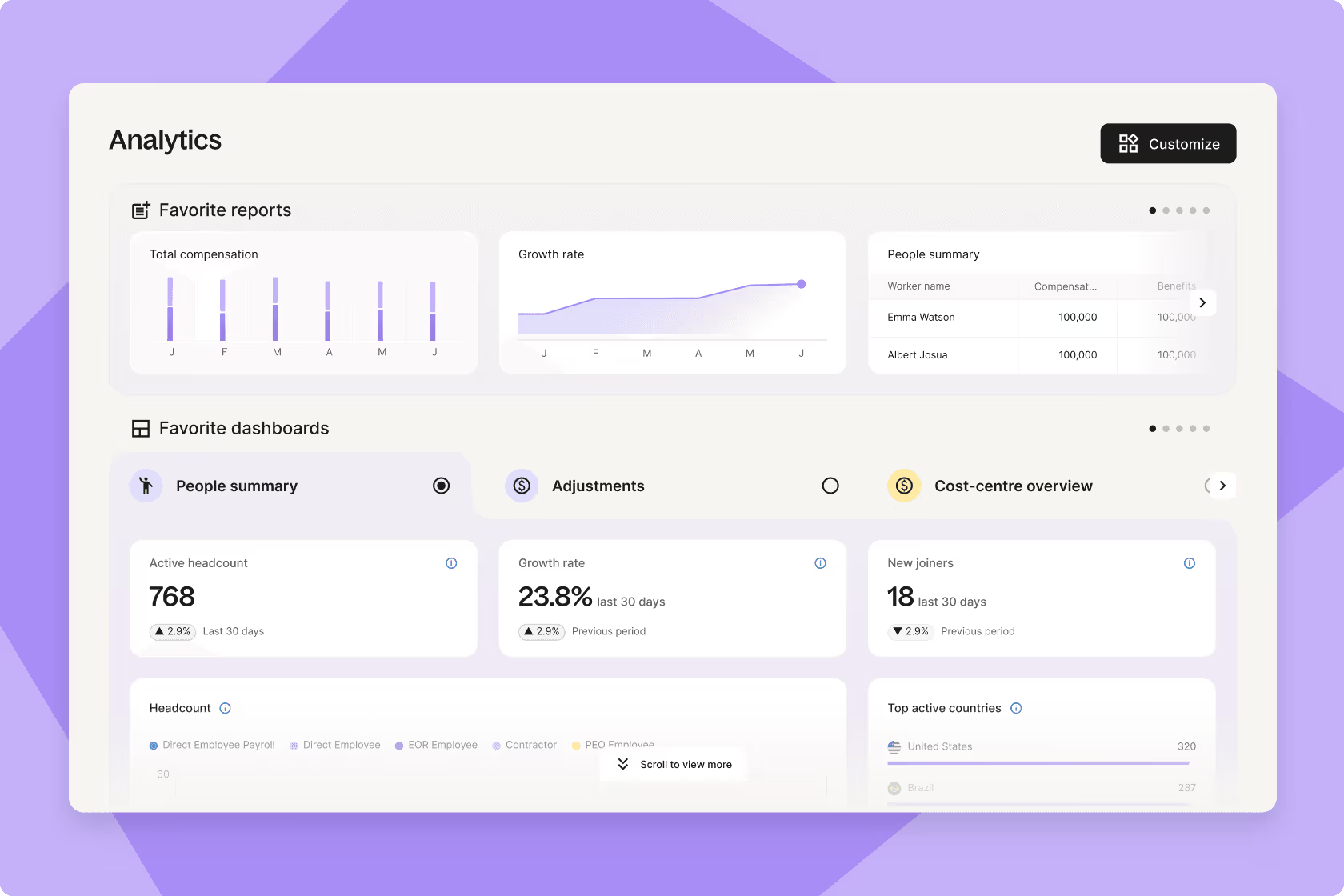
It's not just startups betting on it either. Deel's customer list includes Dropbox, Zapier, Shopify, Notion, Intercom, Reddit, Revolut, Nike, Reebok, Red Bull, Subway, Calvin Klein and other names you'll recognize.
Pricing:
• EOR from $599 per employee per month on annual billing, with volume discounts reported in the $350–$500 range for larger teams.
• Contractor management from $49 per contractor per month.
• Global payroll on your own entities from around $29 per employee per month.
One thing worth planning for: Deel asks for a deposit of roughly one month's gross salary per EOR employee before onboarding. Rates in this space shift a lot, so double check current pricing on their site before you commit to anything.
Verdict: The category leader for a reason. Want one platform to run both employees and contractors across a wide spread of countries? Start here.
2. Rippling: Best Workforce Management Platform for Unified HR + IT + Payroll
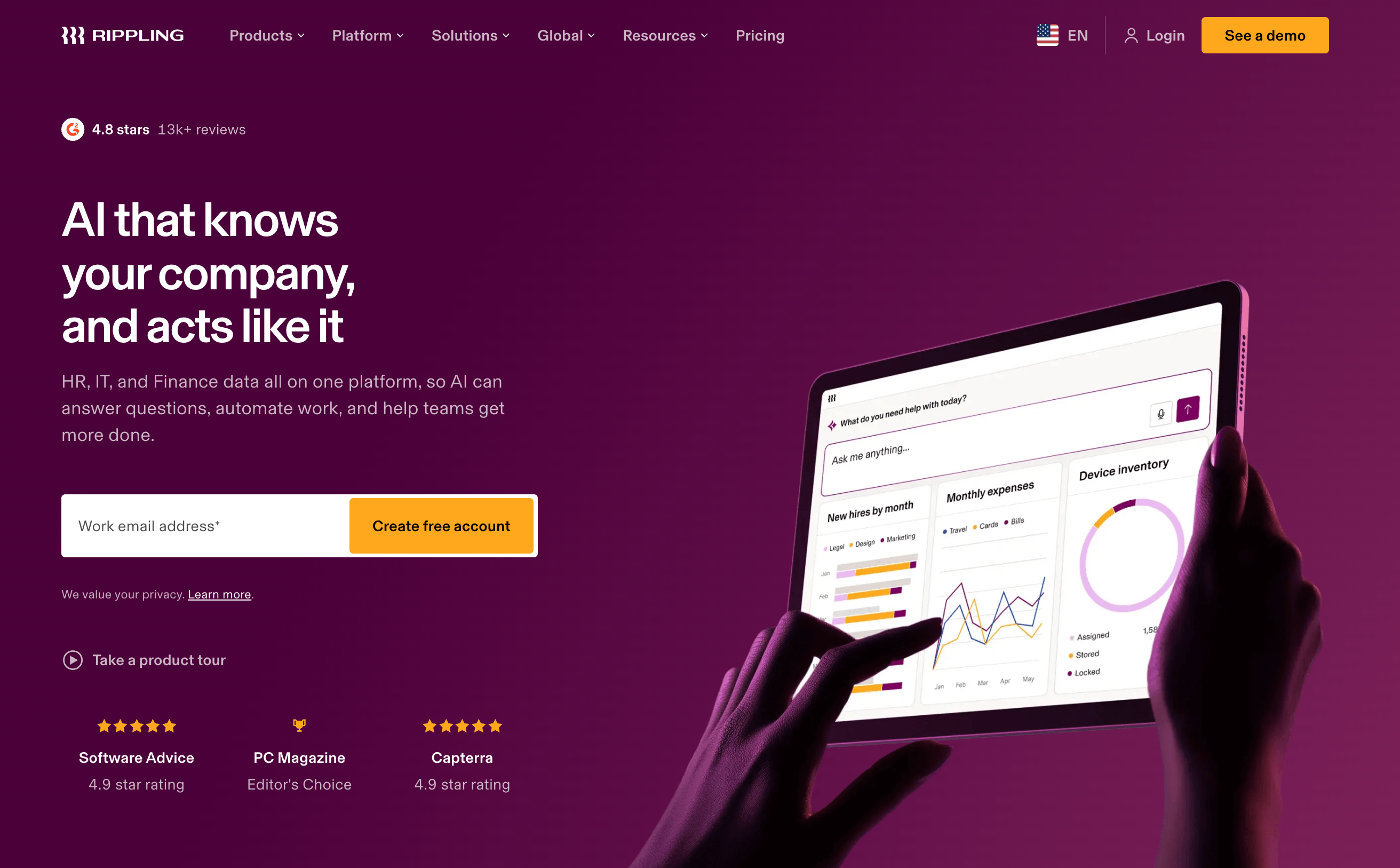
Rippling is playing a different game than everyone else on this list. It's a full workforce management platform, HR, payroll, IT and finance all running on a single employee record, rather than a payroll service with a few extras bolted on. Hire someone in London and one workflow creates their contract, runs their payroll, ships their laptop, sets up their app access and permissions. When they leave, one click undoes all of it. Nobody else on this list can pull that off.
Its global reach holds up too: payroll across 185+ countries and EOR in roughly 50–80 markets. The clever part is that Rippling runs native payroll in major markets like the UK, Canada and Australia, so if you open your own entity there, you skip EOR fees entirely and just pay normal payroll-software rates instead. Add 500+ integrations, the biggest ecosystem in the category, and it becomes the obvious pick if you're trying to untangle a messy tool stack.
Having used Rippling as an employee myself, I'll be honest about where it falls a bit flat: Rippling next to Deel feels kind of old school. Something as simple as booking time off took me way longer to figure out than it should have, the button just isn't where you'd instinctively look for it. So budget some patience for the interface, especially in your first few weeks on it.
Pricing: modular and quote-based, starting around $8 per user per month for the core platform, with EOR reported at roughly $499–$599 per employee per month. The lack of published pricing is a genuine drawback, every module needs a custom quote, which makes budgeting harder, and off-cycle payroll runs in partner-delivered countries can carry a ~$50 per-employee fee.
Verdict: The best workforce management platform, full stop. Get it to consolidate your operations, not just to run payroll.
3. Oyster: Best for Employee Benefits and Experience
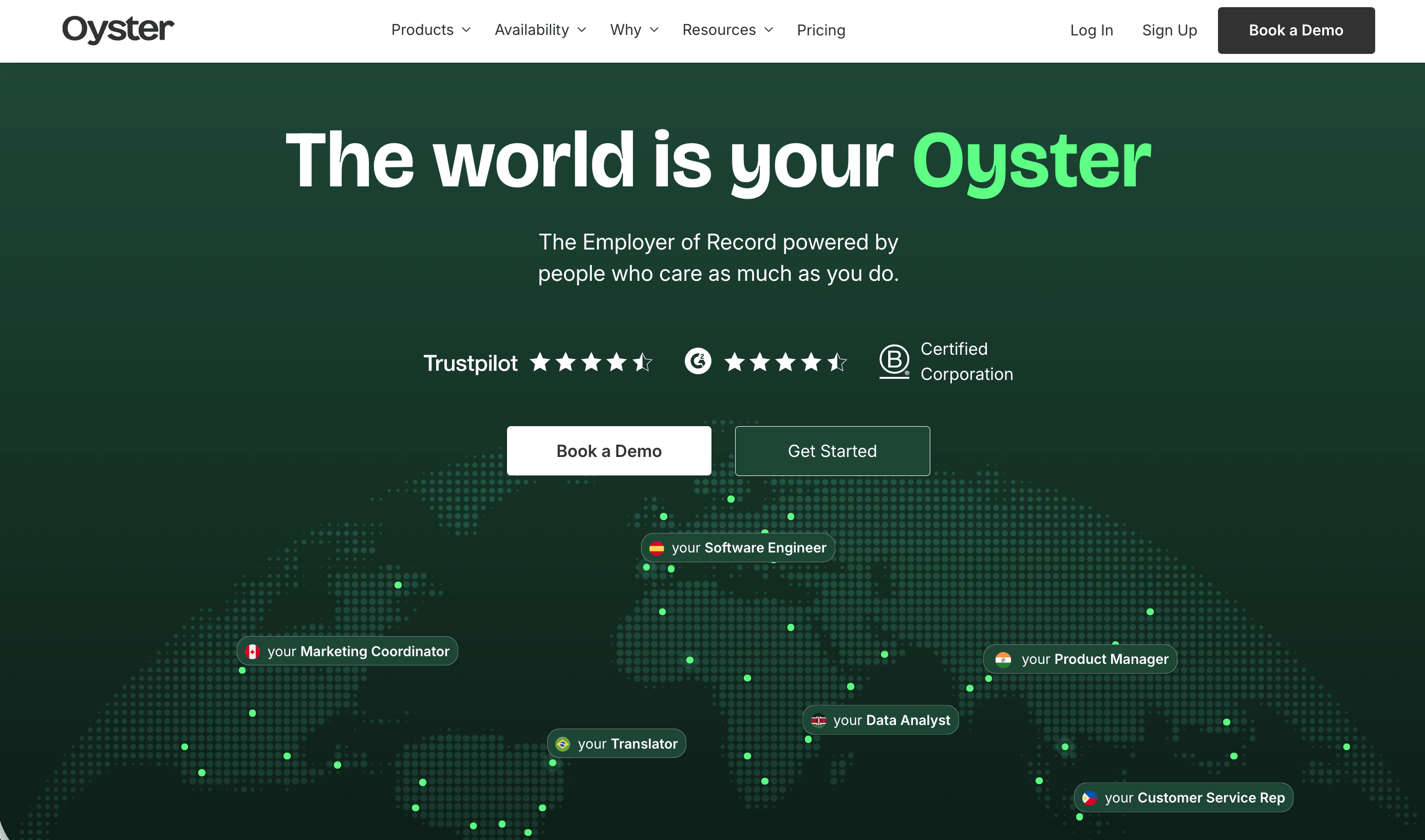
Oyster is the provider your new hires will end up thanking you for. It's a B-Corp-certified EOR covering 120+ countries, and it's known for having the most polished onboarding experience in the category, genuinely competitive localized benefits packages, and dedicated customer success managers backed by a 24-hour response SLA. If your hiring pitch to international candidates leans on "we actually treat our people well," Oyster is the one platform here that backs that up in practice, not just in copy.
It's also refreshingly simple to buy. One flat published price, no confusing module maze to click through. Coverage is strong in markets other providers tend to treat as an afterthought too (Southeast Asia, Africa, Eastern Europe), and Oyster Academy throws in free training resources if you're managing a distributed team for the first time.
Pricing:
• $699 per employee per month flat for EOR, with volume discounts reported around $450–$500 for bigger teams.
• Contractor plans run separately at about $29 per contractor per month.
That flat rate is the highest price tag in this guide, and Oyster doesn't disclose its FX markup on salary conversions, so ask about that one specifically before you sign.
Verdict: Pick Oyster when candidate experience and benefits quality are what's actually deciding this for you, and you're okay paying a premium for it.
4. Payoneer Workforce Management: Best for Contractor Payments
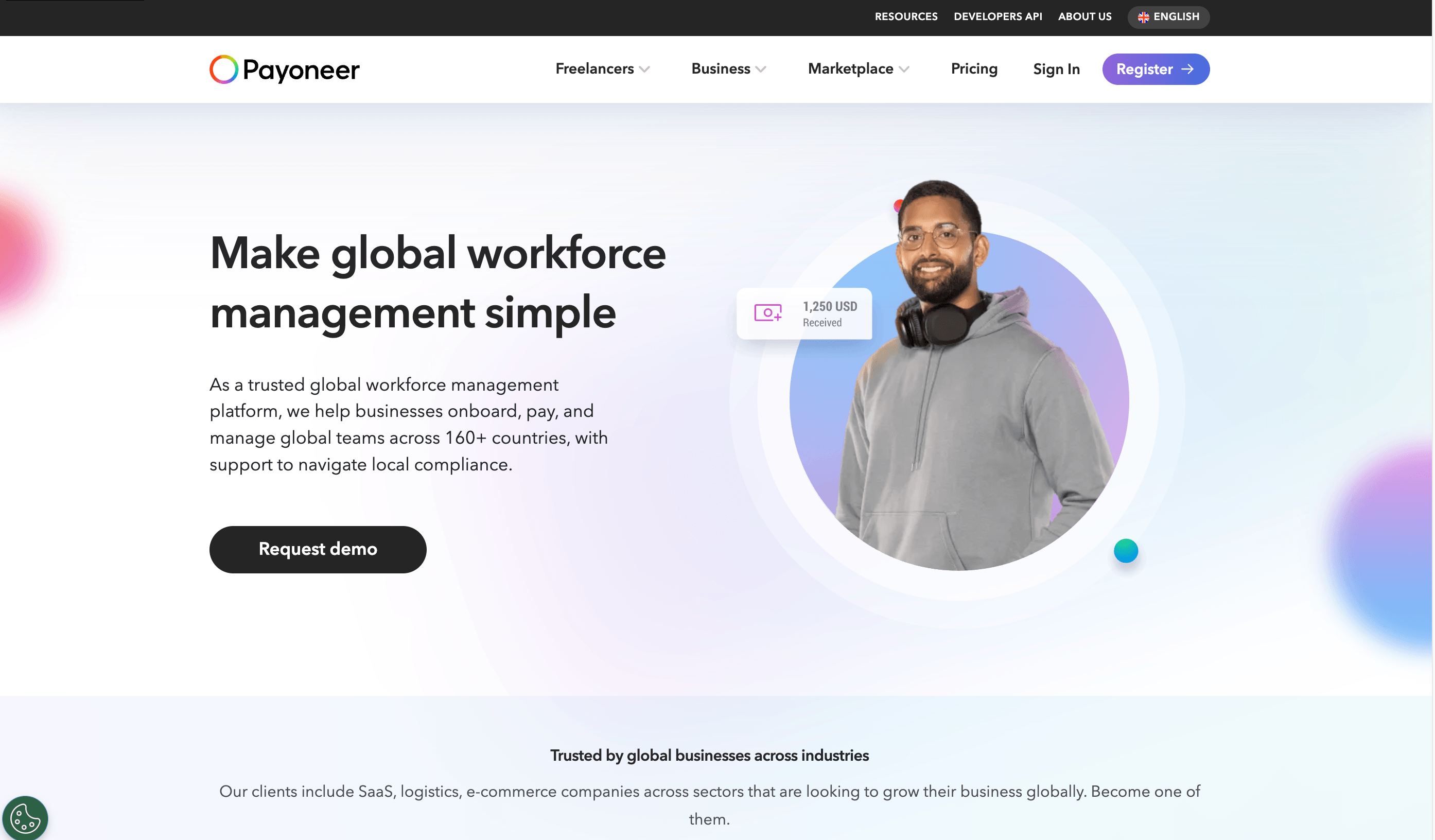
Payoneer Workforce Management (formerly Skuad) is the price disruptor on this list, and there's real infrastructure behind that lower number, not just a discount for the sake of it. EOR starts at $199 per employee per month, about a third of what Deel or Oyster charge, with contractor management from just $19 a month and zero setup or offboarding fees. Behind it all sits Payoneer (NASDAQ: PAYO), a cross-border payments company moving over $80 billion a year, which picked up Skuad in 2024.
That payments backbone is honestly the real differentiator here. Salary and contractor payouts run on infrastructure that pure-play EOR startups usually rent from someone else. The platform itself is clean and simple to use, coverage spans 160+ countries with real depth in Asia-Pacific and emerging markets, and G2 named it a Spring 2026 Leader across four regions: Americas, Europe, MEA and APAC.
Full transparency here: I use Payoneer's bank account daily for international transfers, and the payment rails are as solid as advertised, which is exactly why it earned a spot in our digital nomad banking guide. I haven't personally run the Workforce Management product itself though, so take my read on it as leaning on verified user reviews, research and a few friends' experiences rather than hands-on testing.
Pricing:
• EOR from $199 per employee per month.
• Agent of Record from $99 per contractor per month, contractor management from $19 per contractor per month.
The catch: $199 is just the entry point, and country-specific surcharges can push EOR up toward $600 in some markets. FX spreads aren't disclosed either. Get your target countries quoted in writing before you commit.
Verdict: The best entry price in the category, backed by genuinely strong payment rails. Just get country-level pricing in writing first, then enjoy the savings.
5. Papaya Global: Best for Enterprise Multi‑Country Payroll
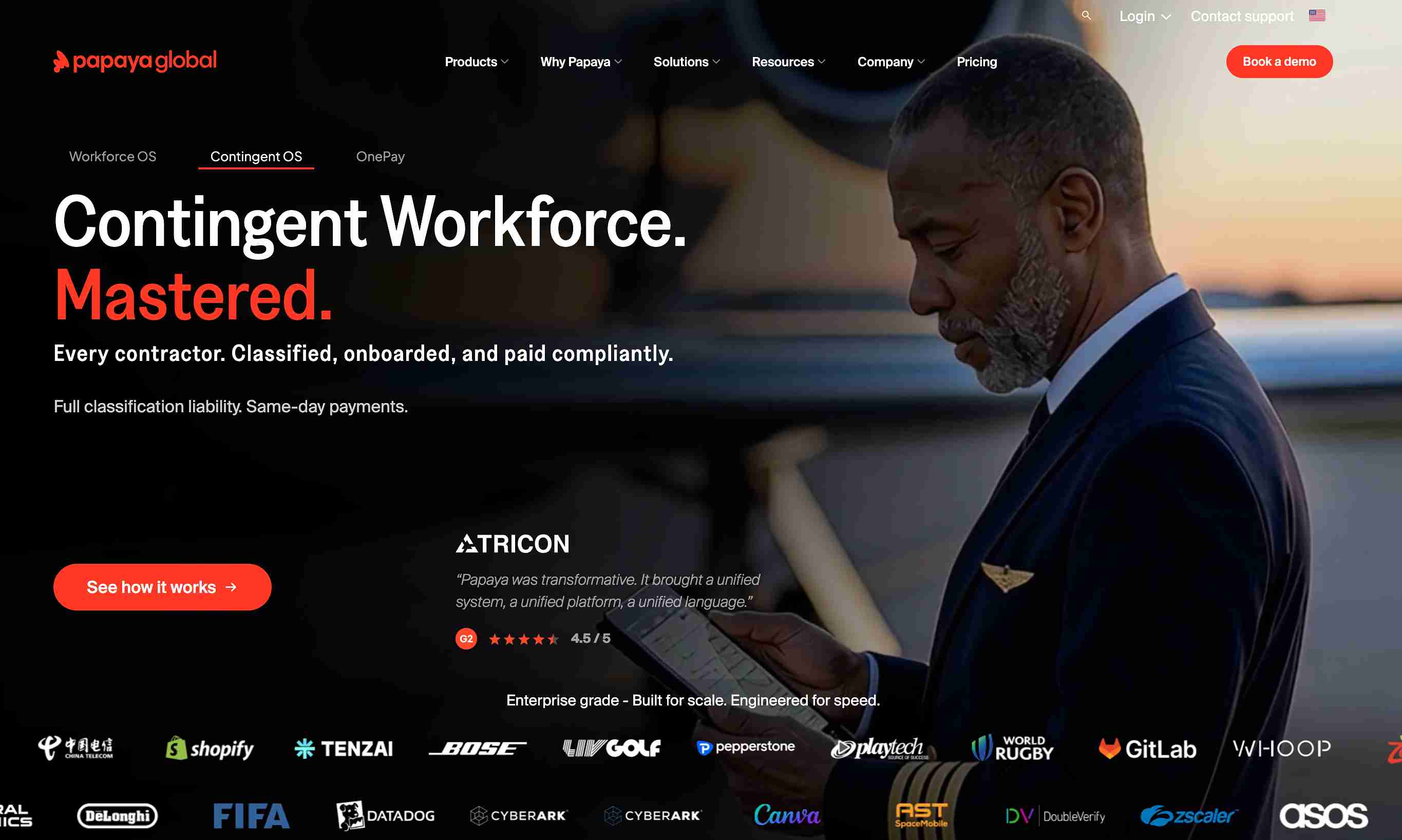
Papaya Global is what you graduate to, not what you start with. It's an enterprise-grade workforce platform built around the deepest payroll analytics and payments infrastructure in this whole comparison, covering 160+ countries. Its sweet spot is companies running 50+ employees across five or more countries, where a finance team is buried in reconciliation work across a bunch of providers and currencies.
Here's the honest way to think about it: if your CFO is spending ten-plus hours a month untangling payroll data across countries, Papaya's consolidated reporting pays for itself pretty quickly. It also runs licensed payments infrastructure, which matters if you're in a regulated industry or moving large amounts of money. But if you're hiring your first three people abroad, you'd basically be paying for analytics you could replicate in a spreadsheet.
Pricing:
• EOR typically runs $650–$770 per employee per month, with some tiers starting around $499.
• Own-entity global payroll starts around $25–$30 per employee per month.
Worth knowing: a lot of Papaya's EOR is delivered through local partners rather than owned entities, and its FX fees aren't disclosed either. Both are worth bringing up on the sales call.
Verdict: The enterprise pick. Great choice at 50+ international employees spread across many countries, overkill for your first few hires abroad.
6. RemotePeople: Best Budget-Friendly Option with Dedicated Support
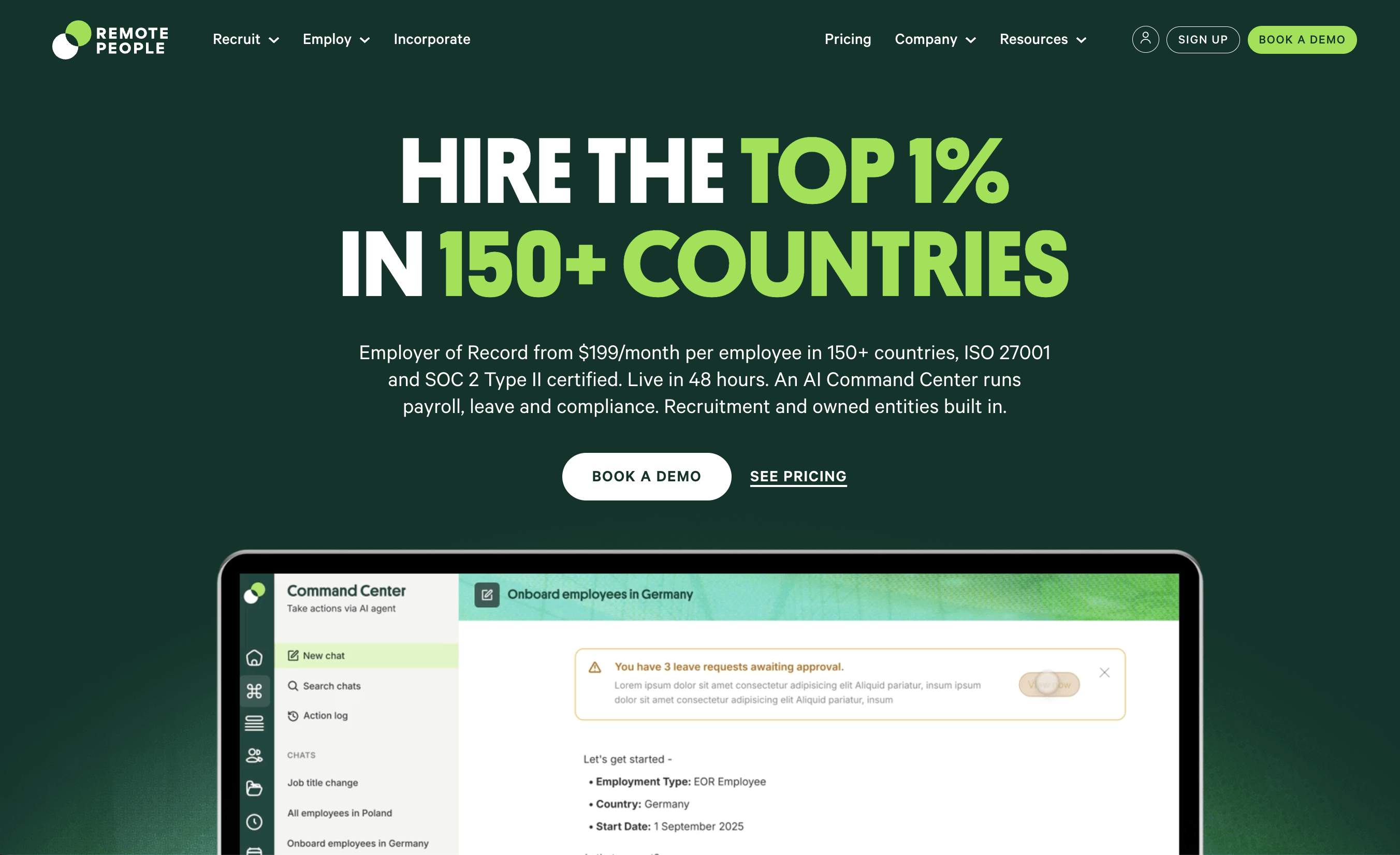
RemotePeople (formerly Horizons) solves a problem literally no one else on this list touches: it finds the people, then employs them. Every other provider assumes you've already got a candidate lined up. RemotePeople pairs in-house international recruiters, drawing on a 500,000+ candidate pool, with EOR services delivered through its own local entities in 150+ countries, so sourcing, hiring and compliant employment all happen through one vendor without any handoffs in between.
The price undercuts the legacy players too, and it doesn't feel like you're getting less for it. EOR starts at $199 per employee per month flat, and users on G2 keep saying the lower price hasn't meant worse service: the platform holds a 4.7/5 rating across 415+ verified G2 reviews and was named a best Employer of Record for 2026 by G2, People Managing People and SelectSoftwareReviews. Every client gets a dedicated account manager too, no ticket queues, no chatbots to argue with. There's also an AI assistant called Command Center that handles routine HR tasks (onboarding, salary changes, amendments) in plain language, with real humans reviewing anything higher stakes.
Pricing:
• EOR from $199 per employee per month, contractor management from $29 per contractor per month.
Worth checking first: coverage varies by product. EOR spans 150+ countries, global payroll 100+, visa support 80+, so confirm your specific markets before you sign anything.
Verdict: If you still need to find the talent abroad, not just employ them once found, this is the only platform actually built for that whole journey, at budget pricing too.
7. Gusto: Best for US Companies Hiring International Contractors
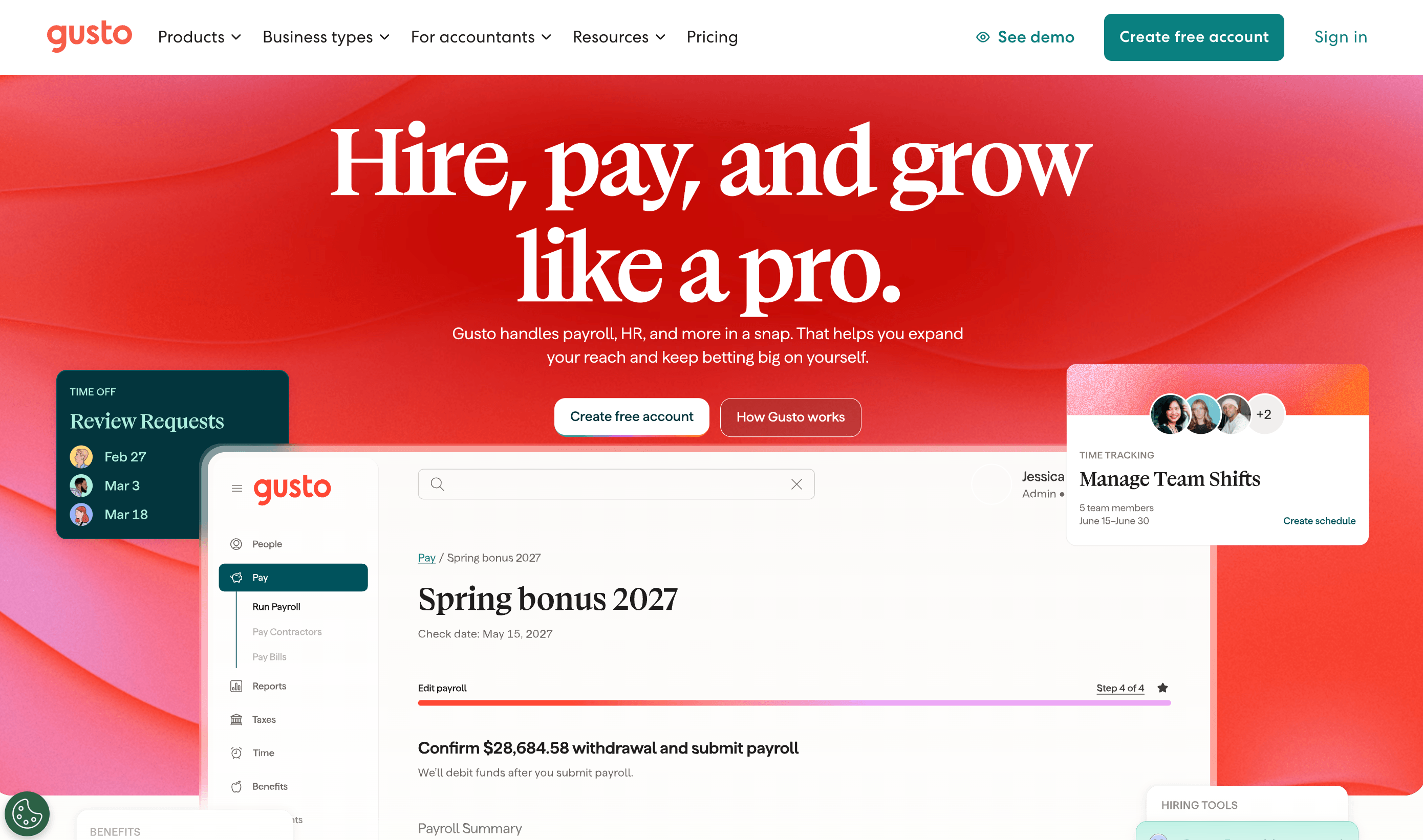
Let's be upfront about what Gusto actually is: the best US small-business payroll platform, used by 400,000+ businesses and past $1 billion in annual revenue as of 2026, with an international add-on tacked on top. It's not a global-first platform, and pretending otherwise is exactly how companies end up switching providers a year later feeling burned. But if your team is 90% American and you just want to pay a designer in Portugal and a developer in Argentina from the same system already running your US payroll, Gusto is genuinely the least disruptive way to do it. It also plays nicely with the accounting software most US small businesses already use.
International contractor payments cover 120+ countries. Full international employees go through Gusto Global, an EOR delivered in partnership with Remote covering roughly 12+ countries. That partnership model is the key thing to understand here: Gusto handles your billing and interface, but Remote is the actual legal employer, which splits accountability the moment something goes sideways on a termination or tax audit.
Pricing:
US plans are published and contract-free:
• Simple at $49/mo + $6 per person;
• Plus at $80 + $12, Premium at $180 + $22;
• Contractor-Only plan at $35/mo + $6 per contractor.
Gusto Global EOR runs $599–$699 per employee per month after a March 2026 price increase. They've raised prices twice within 12 months now, so build that trend into any multi-year budget you're planning.
Verdict: The right tool if the US is your center of gravity. If international hiring is actually your growth strategy rather than an occasional exception, go with a global-first platform instead.
Which One Should You Choose?
Match the platform to your actual situation, not to whatever the marketing page tells you.
After going through dozens of these platforms, the pattern is honestly pretty simple: pay for coverage you'll actually use. A $199 EOR beats a $699 EOR if both cover your target countries and handle compliance through solid local infrastructure. The premium providers earn their price through breadth, analytics or platform depth, not through better basic compliance.
Global Payroll, EOR and Workforce Management: What's the Difference?
Vendors throw these terms around interchangeably, which just causes expensive confusion down the line. So here's what each one actually means:
A global payroll service is software or a managed service that calculates and pays salaries, withholds taxes and files reports for workers in multiple countries, typically where your company already owns legal entities. It consolidates a bunch of local payrolls into one system and one report, usually for $20–$30 per employee per month.
An Employer of Record (EOR) is a company that legally employs workers on your behalf in countries where you have no entity. The EOR owns the employment contract, payroll, taxes and statutory benefits, while you direct the day-to-day work. Typical EOR pricing in 2026 runs from $199 to $770 per employee per month depending on provider and country.
A workforce management platform is software that pulls together HR, payroll, time and attendance, and often IT and finance for a distributed team on a single employee record. Rippling is the classic example: instead of separate tools for payroll, devices and app access, one system drives all of it from the same data.
How We Evaluated These Platforms
We compared each provider on published pricing and pricing transparency, EOR and payroll country coverage, compliance model (owned entities versus third-party partners), support quality and verified user reviews across G2, Capterra and Trustpilot, plus what people are actually saying in communities like r/Payroll. We didn't run live payroll on all seven platforms ourselves, and anywhere a claim comes from vendor documentation rather than something we could independently verify, we say so and suggest confirming it on your sales call. Rankings are never influenced by affiliate partnerships. We take the same approach across all our small business tool reviews.
The Bottom Line
You really don't need to demo all seven of these. Deel is the safe default for most companies hiring internationally. Payoneer Workforce Management or RemotePeople will save you roughly $400 per employee per month if your target countries are covered, and RemotePeople throws in recruitment on top if you haven't found the person yet. Rippling is the pick when the real problem is five disconnected systems, not payroll itself. Prices verified August 2026, but always double check current pricing with the vendor directly, because things move fast in this industry.
Whichever you pick, most of these offer a demo or a pilot with one or two hires before you sign a full agreement. Use it.
More from
Small Business
category