.svg)


A high school resume template built for someone with no work experience looks nothing like a standard resume, and if yours does, that's likely the first thing working against you.
I've reviewed enough entry-level applications to know the pattern: a student downloads a generic Word template, stares at "Work Experience," panics, and either submits something half-filled or gives up. Neither outcome is the student's fault. The template wasn't designed for them.
Here's what actually belongs on a high school resume, what to cut, and why the format matters more than most people tell you.
What a high school resume template actually is

A high school resume template is a structured, one-page document that helps students with little or no work experience present their skills, education, activities, and achievements in a format employers and college admissions readers can quickly evaluate. Unlike professional resumes, a resume template for high school students replaces the work history section with sections for extracurricular activities, volunteer work, school projects, and relevant skills.
The mistake every high school resume makes
Trying to look like an adult resume.
A template with five blank bullet points under "Work Experience" doesn't just fail to help. It frames the entire document around what you don't have. Recruiters at retail stores and local businesses are not expecting a polished professional. They want someone who shows up and follows instructions. Your resume just needs to clear that bar.
For college applications, the frame shifts but the principle holds. Admissions readers want to see how you spent your time. Copying the format of a 35-year-old's resume tells them nothing useful.
What to actually put on it
Contact info. Name, phone, email, city. Nothing else. No full address.
About Me. A two to three sentence summary targeting the specific job you're applying for. Name the role, name the company, mention one relevant trait. "Motivated high school student seeking a part-time position as a barista at [Company Name]. Quick learner with a strong work ethic and a genuine interest in food and beverage." Generic versions get skipped. Specific ones get read.
Education. School name, expected graduation year, GPA if it's above 3.5. Add relevant coursework only if it connects directly to the job.
Skills. This is where most students undersell themselves badly. Google Workspace, Canva, Excel, any software at all, list it. A second language, list it. Cash handling, customer service, time management, all fair game if you've genuinely done them. Hiring managers at a retail job or coffee shop care more about "comfortable with point-of-sale systems" than most students realize.
Extracurricular activities. Sports, student government, debate, drama, volunteering. List the role, not just the activity. "Treasurer, DECA Chapter" is stronger than "DECA Member." The specificity signals that you actually showed up.
Volunteer and community service. One-time events count. School fundraisers, community cleanups, church events,anything that shows you show up for others belongs here.
Projects and achievements. School projects with a real output, honor roll, awards, any academic recognition. Describe your role specifically. "Wo rked in a team of four to develop a mock marketing campaign for a local small business" is a real accomplishment. "Class project" is not.
Work experience (if any). Babysitting, lawn mowing, helping at a family business - this is real experience. Don't leave it out because it feels informal. A student who has been reliably babysitting for two years has demonstrated more accountability than most blank work history sections suggest.
Photo. The template includes a photo section. This is standard in some countries and increasingly used by students to add a personal touch. In the US it's optional, keep it if you want to, skip it if you'd rather not.
For college applications specifically

The sections that matter most for college apps aren't work history. They're activities, leadership roles, and community involvement. Make these prominent and specific. "Captain, varsity soccer, 3 years" tells a story. "Soccer" does not. If you're using this resume for college apps, move activities and achievements higher on the page and trim the skills section slightly. The content is largely the same; the hierarchy changes.
Once you're ready to apply for more competitive roles or internships, it's also worth understanding how ATS systems work. Most larger employers and university programs run every application through one. The ATS resume template guide covers the 7 formatting rules that matter.
What to leave out
A very generic About Me written for no one in particular. References listed on the resume itself. Your middle school history. Anything you'd need to explain or defend in an interview.
One page. Always one page.
Why Canva works better than Word or Google Docs
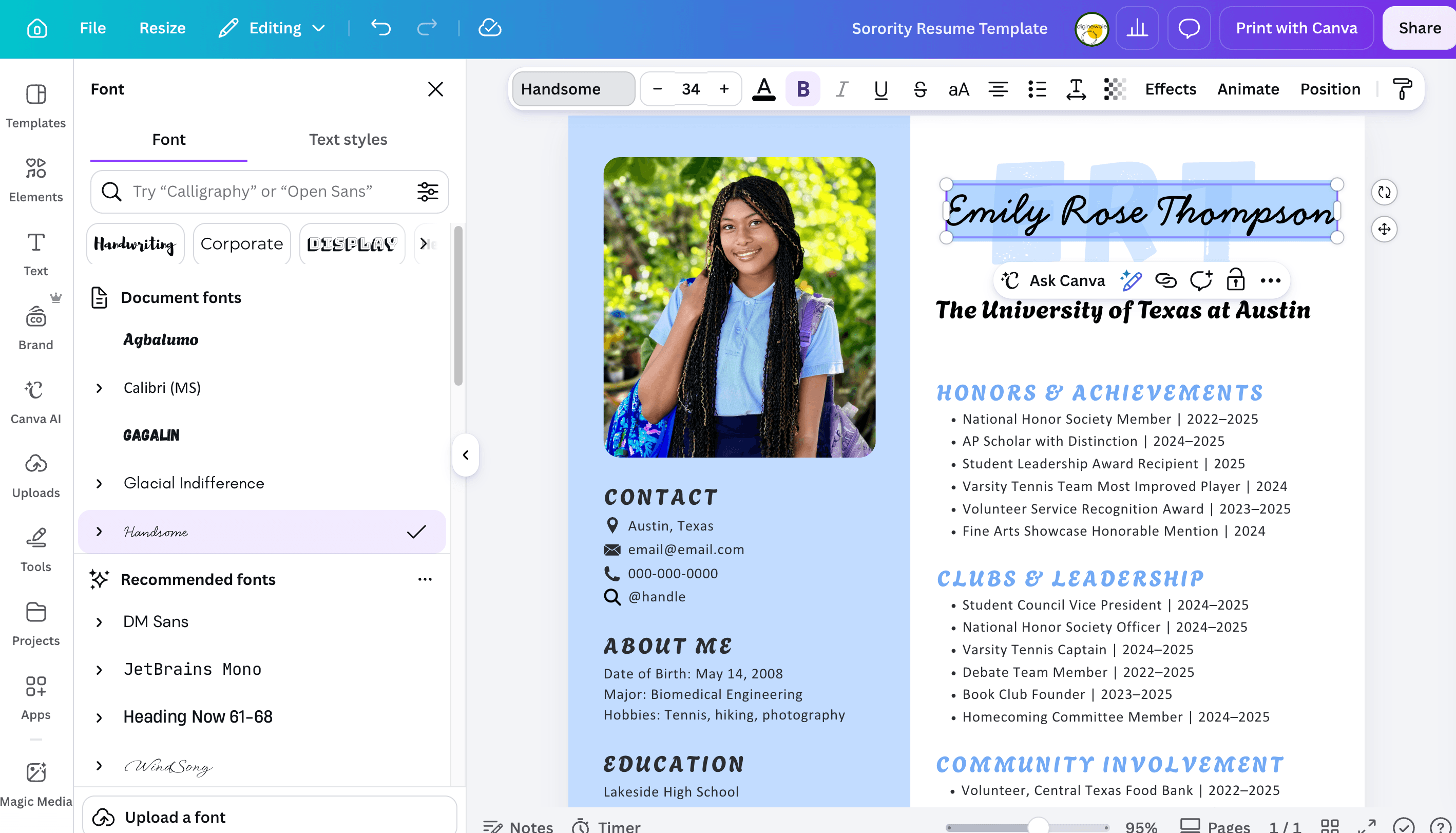
Word templates break when you type. One misplaced tab stop and the entire layout shifts. Google Docs is cleaner but still locked into a fixed structure that wasn't designed for someone whose strongest section is extracurricular activities, not employment.
Canva is visual. You move sections, swap colors, change fonts, and nothing collapses. Most students already use it for school projects, so the learning curve is effectively zero. The output looks intentional, not like a school assignment.
That said, not all Canva resume templates are built with a high school student's specific situation in mind. Most are just adult templates reformatted. The one that actually skips the work history section and replaces it with the right sections from the start is this bundle: Editable High School Student Resume Template Canva | Cover Letter, References. Every section has placeholder text with real examples showing exactly what to write. No blank page panic.
Here's what's inside:
- 2 resume designs (yellow-green and olive), both included
- Matching cover letter template
- References page template
- All files in US Letter and A4 sizes
- Bonus Resume Writing and Interview Prep Guide with 16 common interview questions and sample answers
The part most students don't expect: a free bonus Resume Writing and Interview Prep Guide covering formatting, keyword strategy, job search tactics, and 16 common interview questions with sample answers across industries. For someone walking into a first interview at a retail job or summer internship with zero prior experience, that guide alone makes the $6.66 a straightforward decision. It's the difference between showing up prepared and winging it.
If you're further along in your career and need something more advanced, see the best resume templates, a separate roundup covering templates for different career stages.
A note on free templates
Free templates exist everywhere and they're fine for getting something submitted fast. The problem isn't quality. It's that they're generic, and generic doesn't stand out when five other applicants submitted the same layout. If you're applying to a few places and just need something functional, free works. If you're putting together a college app portfolio or applying anywhere competitive, a template that looks like everyone else's is a liability.
The time spent reformatting a broken Word doc is rarely worth the money saved.
When you're ready to go beyond the resume and start thinking about how to actually land the job, this guide on finding work through the hidden job market is a useful next read.
Frequently asked questions about high school resume
More from
Resume and Career
category